10 Home Energy Myths Debunked

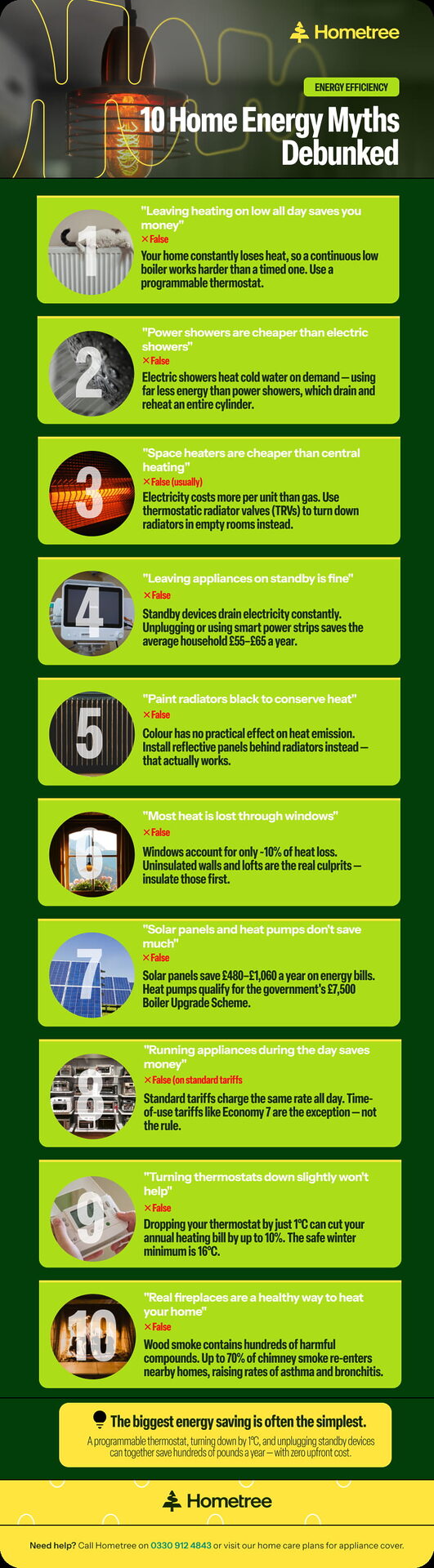
Many common beliefs about saving energy at home are actually myths.
Debunking these myths will help you make better decisions that will reduce your energy usage and bills.
Myth #1: “It’s cheaper to leave your heating on low all day.”
No, it’s not cheaper to leave your heating on low all day.
Keeping your heating on all day means your home is constantly losing energy. Your boiler has to run continuously to replace it. So, you waste more fuel than only heating your home when you need it.
In fact, the most effective way to cut heating costs is to install a programmable thermostat or timer.
This ensures your heating only activates when you are at home.
Myth #2: “Power showers are cheaper than electric showers.”
No, electric showers are much cheaper to run than power showers.
The mechanical differences between these two types of shower lead to different energy usages, too.
A power shower draws water that has already been pre-heated by your central boiler or hot water cylinder.
It uses an internal electric pump to increase the water pressure and spray a lot of hot water quickly.
This drains your hot water cylinder in minutes. So, your heating system has to work hard to reheat a fresh cylinder of cold water.
Meanwhile, an electric shower takes cold mains water and heats it instantly on demand. Its process for this uses much less water and energy for the exact duration of your shower.
Myth #3:“It’s cheaper to heat one room with a space heater than the whole house with radiators.”
No, running individual electric space heaters in single rooms is usually more expensive than using your gas central heating.
Electricity is much more expensive per unit than natural gas. It might seem logical to turn off your central heating and use a plug-in heater in the room you’re in. But it will rapidly inflate your electricity bill.
The only exception is if you’re in a small flat, where the cost for using gas heating and electricity per square foot is similar.
But in most other homes, the cheapest way to manage your heating is to keep your central boiler running but use thermostatic radiator valves (TRVs) to turn down the radiators in empty rooms.
Myth #4: “Turning appliances off but leaving them plugged in is fine.”
No, leaving appliances plugged in on standby still drains electricity and increases your bills.
Modern electronic devices utilise standby power even when they are turned off. These standby energy vampires draw small amounts of electricity over time. Common examples include:
- Games consoles
- TVs
- Microwaves
- Phone chargers.
Unplugging these devices at the wall or using smart power strips cuts this electricity drain. It can save the average household between £55 and £65 a year in wasted power.
Myth #5: “Paint your radiators black to conserve heat.”
No, painting your radiators black has no real effect on heat emission.
This myth is based on the fact that dark colours are effective at absorbing heat. However, this makes no practical difference to the warmth of your room.
It’s often best to leave your radiators white to match your home decor. To increase your radiator’s efficiency, install reflective radiator panels behind. It reflects escaping heat back into the room.
Myth #6: “Most lost heat goes through windows.”
No, windows only account for up to 10% of heat loss in a typical home.
Double or triple-glazed windows are essential for reducing cold draughts and maintaining comfortable indoor temperatures.
However, windows are not the main path through which your home loses its warmth. Uninsulated solid or cavity walls are.
Ensuring your walls and loft are properly insulated is the most effective way to lock in warmth and reduce your reliance on central heating.
Myth #7: “Solar panels and heat pumps do not save much money.”
No, eco-friendly systems like solar panels and heat pumps can save you hundreds of pounds a year while reducing your carbon footprint.
While these renewable technologies require initial upfront installation costs, they provide massive long-term financial and environmental benefits. They dramatically reduce your reliance on expensive fossil fuels.
Solar panels
Solar panels generate clean electricity directly from the sun. Over time, they can reduce your energy bills by £480 to £1,060 a year.
And they can even earn you ongoing revenue by exporting surplus power back to the grid through the Smart Export Guarantee (SEG).
Heat pumps
Heat pumps deliver highly efficient heating and cooling by transferring heat from the outdoor air, ground, or water.
Homeowners in England and Wales can significantly offset installation costs by applying for the government’s £7,500 Boiler Upgrade Scheme.
Myth #8: “You can save money by using appliances during the day.”
No, running appliances during the day is only cheaper if you are on a specific time-of-use tariff.
Standard electricity tariffs charge the exact same flat rate for power regardless of when you use it.
For these standard tariffs, running your washing machine at midday or midnight costs the exact same amount.
However, if you are signed up to a time-of-use tariff like Economy 7, you will secure much cheaper electricity during off-peak hours (typically between 12 a.m. and 6 a.m.).
While off-peak rates are highly cost-effective, you must be careful—the peak daytime rates on these tariffs are often significantly higher than standard flat rates.
Myth #9: “Turning the thermostat down slightly won’t save money.”
No, turning your thermostat down by just one degree can reduce your annual heating bill by up to 10%.
Many households believe that small temperature adjustments make no real difference, leading them to take extreme measures instead.
However, lowering your thermostat by a single degree is the fastest, easiest way to lower your energy bills.
Older guidelines recommended keeping indoor temperatures at 21°C, which many believe is optimal for comfort. However, current official UK health advice states that 18°C is the safe minimum temperature for a home in winter.
Lowering your thermostat slightly is a zero-effort habit that immediately reduces your bills.
Myth #10: “Real fireplaces (& wood burners) are healthy, natural ways to heat your home.”
No, wood smoke is highly toxic and is a major source of both indoor and outdoor air pollution.
Many homeowners assume that because wood is natural, burning it in a fireplace or woodstove must be benign.
In fact, wood smoke contains hundreds of carcinogenic, mutagenic, and highly irritating compounds.
This includes benzene and microscopic particles so fine that they bypass our natural respiratory defenses and travel directly into the lungs and bloodstream.
And once they are in the bloodstream, they increase the risk of heart attacks and respiratory illnesses.
The damage is not only confined to your own living room. Research shows that up to 70% of chimney smoke reenters nearby homes, raising rates of:
- Asthma
- Bronchitis
- Compromised lung function (especially in local children and the elderly).
For most UK households with access to gas or heat pump alternatives, burning wood is usually recreational and therefore easily avoidable.
Central heating truths
Not all consensuses are wrong. Below are commonly known truisms about central heating.
Truth #1: “Turning off lights saves money.”
Yes, turning off lights when you leave a room always saves money on your electricity bills.
Many homeowners wonder if this old rule still applies now that highly efficient LED light bulbs are standard.
LEDs use significantly less electricity than traditional incandescent bulbs, meaning they cost very little to run.
However, leaving any light on in an empty room still wastes energy. Flicking the switch when you leave is a zero-cost daily habit that prevents waste.
And over a full year, those minor electricity savings across your entire home will add up to a noticeable reduction in your bills.
Truth #2: “Boiling a full kettle costs energy.”
Yes, boiling more water than you need in a kettle wastes a substantial amount of energy.
Kettles are highly energy-intensive appliances because they require a large amount of electricity to heat water to a boil quickly.
Filling a kettle to the top when you only want to brew a single cup of tea forces the appliance to run for much longer, consuming unnecessary power.
Only filling your kettle with the exact amount of water you need is a simple, zero-cost habit. This simple change can reduce:
- Boiling time
- Wear on your appliance
- Daily electricity usage.
Truth #3: “Tumble dryers use more energy than washing machines.”
Yes, tumble dryers use significantly more electricity than washing machines per cycle.
Tumble dryers are among the most energy-intensive appliances in UK households, making them highly expensive to run.
While they are incredibly convenient during cold winter months, relying on them heavily will drive up your electricity bills.
To keep your bills low, it is highly recommended to hang your clothes on an outdoor washing line or use an indoor airer whenever possible.
This zero-cost alternative protects your clothes and cuts your appliance energy consumption to zero.
Get your central heating covered with Hometree
Our central heating cover includes unlimited repairs, an annual boiler service, zero parts & labour charges, and 24/7 claims support to keep your home warm. Subject to exclusions and T&Cs apply.
With no hidden fees and coverage across England, Scotland, and Wales, we’ve got you covered.
You can get covered today or contact us for a free quote.


We Beat or Match Any Quote
Phone us to beat or match British Gas or Homeserve quotes, Terms apply.

Serious About Service
24/7 claims support & rated Excellent on Trustpilot

Cover Match Guarantee
£50 gift card if we don’t cover something British Gas or Homeserve do, terms apply

All Gas Boilers Covered
All makes and models, regardless of age