How to Clean a Dishwasher

A 2013 study in the International Journal of Consumer Studies found that washing a full dishwasher load by hand takes between 65 and 106 minutes, compared to just 9 minutes to load and unload the same amount into a dishwasher (Berkholz, Kobersky & Stamminger, 2013).
That’s up to 1.7 hours saved every time you run a cycle, or as much as 644 hours a year if you wash dishes daily!
The dishwasher itself dates back further than you’d think. The first practical model was built in 1886 by Josephine Cochrane, a wealthy socialite who wanted to stop her servants chipping her fine china.
However, automatic dishwashers only became widespread in the 1970s.
Naturally, most of us take this appliance for granted nowadays. Many of us even forget that you should clean it occasionally…
Why cleaning your dishwasher is important
Even though it is a cleaning machine, a dishwasher does not clean itself. Like all appliances, it requires routine maintenance.
Debris (food, grease, and soap) accumulates in different parts of it. And neglecting your machine leads to several common issues:
- Odours
- Cloudy glassware
- Weak washes
- Poor drainage or standing water
- Shortened appliance lifespan.
Cleaning your machine monthly reduces the chances of these problems. This in turn can save you money on utility bills and repairs.
How to clean a dishwasher naturally
You don’t need harsh chemical cleaners to deep clean your dishwasher. You can get good results using ingredients from your kitchen cupboard.
The white vinegar wash
White vinegar is a natural acid that breaks down debris and neutralises odours.
- Empty the machine completely.
- Fill a dishwasher-safe cup or bowl with white vinegar and place it on the top rack.
- Run a hot, empty cycle without any detergent.
- Once the cycle is complete, open the door and allow the interior to air dry.
The bicarbonate of soda refresh
As an added freshness, and to remove the scent of vinegar, repeat the process with bicarbonate of soda.
It’s a mild alkali that deodorises the tub and scrubs away remaining surface stains.
- Sprinkle one cup of it soda across the bottom of the empty dishwasher tub.
- Run a hot cycle.
- This process leaves the interior smelling fresh.
Step-by-step guide to cleaning a dishwasher
Step 1: Empty the machine
Remove all dishes, cutlery, and trays.
Take out the removable racks and the cutlery basket. If they are greasy, wash them separately in your sink with warm and soapy water. This gives you clear access to every corner of the tub.
Step 2: Clean the filter
The filter catches stray debris. It’s often the first place that smells or causes low drainage if not cleaned regularly.
- Locate the filter assembly in the base of the machine
- Twist and lift the filter to remove it
- Rinse it under warm running water
- Scrub the mesh with an old toothbrush
- Clean the empty sump area with a damp cloth
- Screw the filter back into place.
Step 3: Clean the door seal
The rubber door gasket retains moisture, grease, and food. It’s prone to developing mould or odour.
- Wipe around the seal and edges with a damp cloth dipped in warm, soapy water or diluted vinegar
- Use a toothbrush to reach into blocked places or tight corners
- Dry the seal thoroughly with a clean towel. This prevents mould from forming between cleans.
Step 4: Clean the spray arms
Spray arms distribute water around your dishwasher. If limescale or food particles clog the tiny spray nozzle holes, they don’t function well.
- Unscrew or remove the spray arms if your model allows it.
- Soak them in warm, soapy water.
- Use a toothpick or cocktail stick to clear debris from the blocked-up holes.
- Rinse the arms under running water and replace them securely.
Step 5: Clean the exterior
Fingerprints, water splashes, and dust can make your dishwasher look unclean.
- Wipe the door and control panel with a warm, damp, soapy cloth.
- Avoid abrasive sponges or strong chemical cleaners, as they will scratch or ruin the finish.
- If your dishwasher has a stainless-steel finish, wipe in the direction of the grain using a gentle stainless-steel cleaner or a simple vinegar and water solution.
How to remove limescale from your dishwasher
Hard water contains dissolved calcium and magnesium.
When heated, these minerals settle on internal surfaces as limescale. This can lock spray nozzles, clog heating elements, and leave a cloudy haze on your glassware.
To treat active limescale:
- Citric acid cycle: Pour 100 grams of citric acid powder directly into the bottom of the empty tub and run a hot cycle.
- Vinegar wash: Alternatively, run a hot cycle with a cup of white vinegar on the top rack.
- Commercial tablets: For extreme build-up, use a dedicated commercial descaler tablet on an empty cycle.
To prevent limescale returning:
- Dishwasher salt: Always keep the built-in water softener reservoir filled with dishwasher salt. This salt regenerates the ion-exchange system that removes calcium from the incoming water.
- Rinse aid: Regularly refill the rinse aid dispenser. Rinse aid reduces the surface tension of water, allowing it to slide off dishes and preventing mineral spots as they dry.
- Water hardness settings: Program your dishwasher’s internal water softener to match your local water hardness level.
Why does my dishwasher smell?
Different odours point to different mechanical or hygiene issues. Diagnose the scent to solve the problem:
Burning plastic smell
This is common in brand-new machines as the heating elements warm up during early use.
However, in older machines, it usually means a plastic container has fallen through the rack and is melting on an exposed heating element.
Rotten egg smell
This is a sign of decaying food. Check the filter mesh, inspect the rubber door seal for trapped debris, and clear out the sump basin.
Damp, musty mould smell
This indicates standing water and high humidity. Clean the rubber door seals and always leave the door slightly ajar after a cycle to allow the interior to dry.
Sewer or chemical smell
If a foul smell persists after cleaning, food waste may be blocking your kitchen drain pipe or backing up through the wastewater hose.
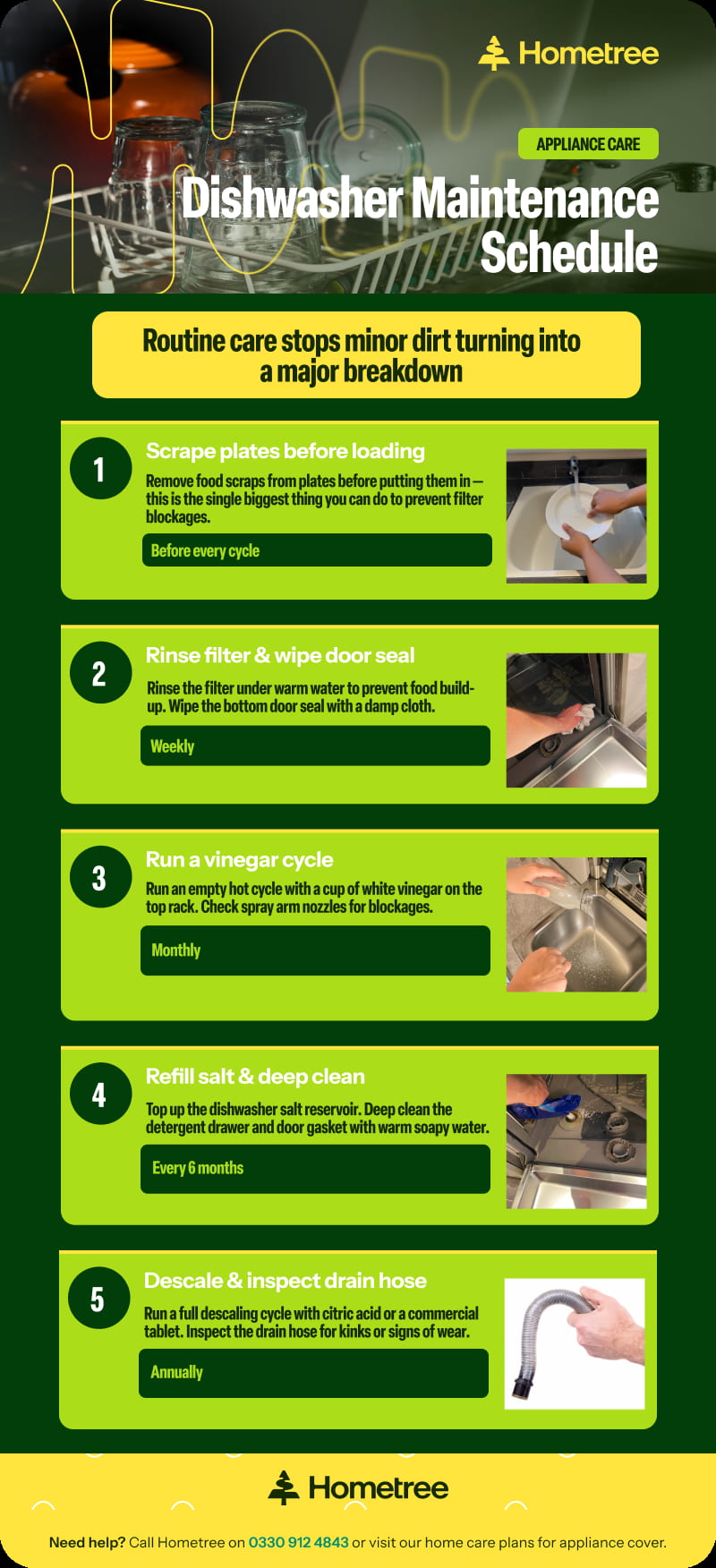
Dishwasher maintenance schedule
Routine care stops minor dirt from turning into a major breakdown. Use this checklist to keep your machine in top condition:
Common cleaning mistakes to avoid
Even with good intentions, some cleaning habits can damage your appliance:
Using bleach
Bleach destroys rubber seals and will permanently corrode stainless-steel tubs.
Ignoring the filter
Waiting until water pools in the bottom of the machine makes cleaning much harder.
Excessive detergent
Too much soap leaves behind a cloudy residue and creates water spots on glassware.
Abrasive scrubbers
Steel wool or harsh sponges will scratch the plastic and stainless-steel interior walls.
When to seek assistance
If your dishwasher still performs poorly, smells foul, or fails to drain after a deep clean, you may have a mechanical fault.
A professional engineer can inspect your machine for hidden clogs, pump failures, or worn or faulty components.
Routine cleaning reduces these risks. But general wear and tear will still occur over time.
Get your home appliances covered with Hometree
Our home appliance cover includes unlimited repairs, an annual boiler service, zero parts & labour charges, and 24/7 claims support to keep your home warm. Subject to exclusions and T&Cs apply.
With no hidden fees and coverage across England, Scotland, and Wales, we’ve got you covered.
You can get covered today or contact us for a free quote.


Get a free appliance cover quote

We Beat or Match Any Quote
Phone us to beat or match British Gas or Homeserve quotes, Terms apply.

Serious About Service
24/7 claims support & rated Excellent on Trustpilot

Cover Match Guarantee
£50 gift card if we don’t cover something British Gas or Homeserve do, terms apply

All Gas Boilers Covered
All makes and models, regardless of age