Gas Fire Not Igniting? Follow These 8 Steps

Can’t switch on your gas fire?
Don’t panic!
Issues with domestic gas fires are often easy to diagnose.
Our simple checks might help you understand what’s going on.
Please note: The following article is aimed at helping you understand potential issues with your gas fire. Always follow gas fire safety precautions and leave diagnosis and repair work to a Gas Safe registered professional.
Know what kind of gas fireplace you have
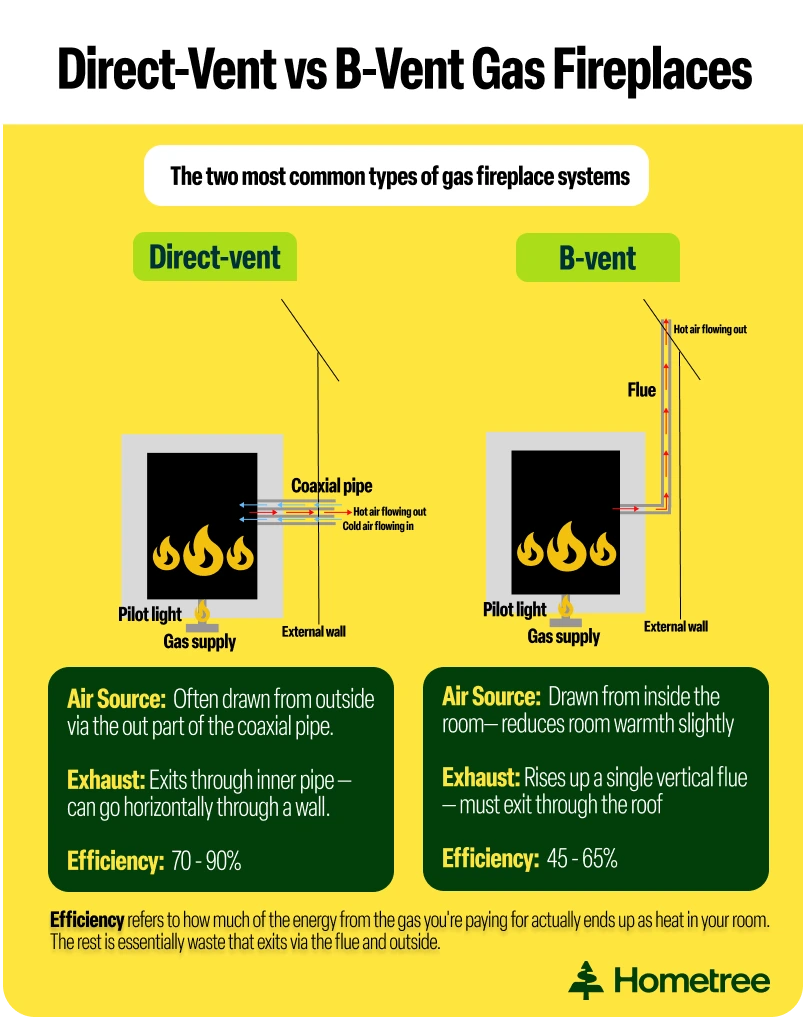
There are two main types of gas fireplaces commonly used in the UK. Before you check yours for other issues, it’s worth understanding which kind you have.
Direct vent
This is the most common type of gas fireplace for new installations.
It typically uses a sealed coaxial pipe (i.e. a pipe within a pipe) to draw in fresh air and release fumes. (Though sometimes two separate parallel pipes are used).
It’s safer, healthier and more efficient than B-Vent systems. It is flexible to install, especially as it can release fumes vertically (through chimneys or roofs) or horizontally (through walls).
B-Vent
These have open vertical flue systems, just like traditional fireplaces.
They use a single exhaust pipe. This is not as flexible to install as direct vents, because it can only release fumes vertically.
Other types of gas fireplace
In the UK, there are also other systems available. However, these are rarer than direct or B-vent systems.
For example, vent-free (or flueless) fireplaces are highly efficient but only available when they meet regulations around room size and ventilation.
And natural (or gravity) vent systems are essentially older, less efficient versions of B-vent systems.
Our top gas fire repair tips
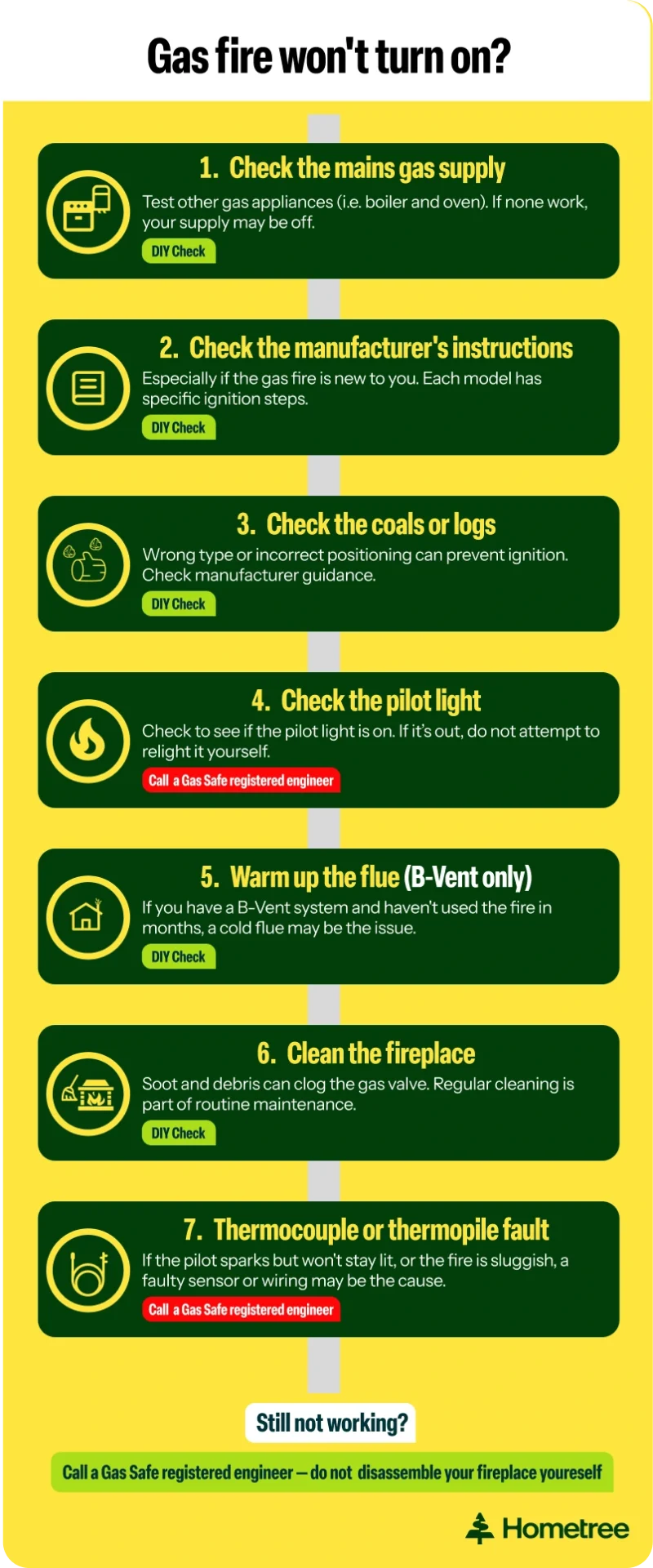
1. Check your home’s main gas supply
The first thing to check is your mains gas supply.
It may have been switched off accidentally. Check to see if other gas-powered appliances are working, such as the boiler or oven.
If the gas mains is off, simply switching it back on might solve the issue.
But if this doesn’t work, the problem might be more extensive. You should contact a Gas Safe engineer immediately.
2. Refer to the gas fire’s manufacturer’s instructions
If your gas fire is newly installed, you likely aren’t used to it yet.
If so, refer back to the manufacturer’s instruction booklet.
It should have step-by-step instructions on turning on and troubleshooting for your gas fire.
3. Check the coals and logs
Replacing your gas fire coals or logs is a part of regular gas fire maintenance.
You should check that you are using the right kind of coals of logs and have positioned them correctly. Check the manufacturer’s instructions for guidance.
4. Check the pilot light
The pilot light on your gas fireplace needs to ignite for your appliance to turn on.
Open the vent to check it. If it is out, you should contact a Gas Safe registered professional.
5. Does the flue need warming up?
If you have a B-vent fireplace (as opposed to a direct vent), your gas fire might not turn on if the flue is cold. This does not apply to direct vent fireplaces.
This is a common issue if it’s been a while since you lit your fireplace, i.e. over the summer months.
6. Clean your fireplace
Soot and other debris build up can clog your fire’s valve, blocking the supply of gas.
7. Thermocouple issues
The thermocouple on your gas fire is the small piece of metal found between the gas valve and the pilot light.
It acts as a temperature sensor and generates a small voltage that keeps the gas valve open.
If your gas fire doesn’t turn on, it may be because the thermocouple isn’t in the right place. It might cause the pilot flame to spark but not stay lit.
It might require an engineer to secure or reposition it.
8. Thermopile issues
In newer domestic gas fires, a thermopile is sometimes used in place of a thermocouple.
They’re very similar in that they work as a sensor and generate a voltage.
If your gas fire is sluggish or won’t turn on at all, it could be down to loose or inadequate wiring.
You will need to have the thermopile tested to see how much energy it is providing and whether or not the wiring in your gas fireplace is adequate.
Checking and replacing thermopiles and wiring is a complicated process and will require the skills and knowledge of a Gas Safe registered engineer.
Still don’t understand why your gas fire isn’t working?
If you have checked the above issues and still can’t find the source of the problem, there could be a fault in your appliance.
Under no circumstance should you ever take apart or tamper with parts of your gas fire. It yourself could endanger yourself and those living in your household.
Leave inspections, servicing and remedial work to Gas Safe registered engineers.
Why gas fire servicing is important
The majority of gas fire problems can be avoided by simply getting your appliance annually serviced.
A gas fire service requires a Gas Safe heating engineer:
- Strip and inspect each part
- Test the safety devices
- Clean it.
This will likely prevent costly repairs or even the need for gas fire replacement in the future.
A gas fire service will also give you peace of mind. It may also be a requirement of your manufacturer guarantee or warranty.
Its cost can be anywhere from £60 – £100.
If you have gas fire insurance, it may be included in your package.
Some companies also offer boiler and gas fire service packages. So, you can get both appliances inspected at the same time, for a cheaper cost.
Get your boiler covered with Hometree
Our boiler cover includes unlimited repairs, an annual boiler service, zero parts & labour charges, and 24/7 claims support to keep your home warm. Subject to exclusions and T&Cs apply.
With no hidden fees and coverage across England, Scotland, and Wales, we’ve got you covered.
You can get covered today or contact us for a free quote.


Get a free home cover quote

We Beat or Match Any Quote
Phone us to beat or match British Gas or Homeserve quotes, Terms apply.

Serious About Service
24/7 claims support & rated Excellent on Trustpilot

Cover Match Guarantee
£50 gift card if we don’t cover something British Gas or Homeserve do, terms apply

All Gas Boilers Covered
All makes and models, regardless of age