The Benefits of Energy-saving Light Bulbs: History, Savings & More

Electric lights have been around since the early 1800s. And yet, they remained a costly and fragile novelty for decades.
Early arc lights consumed too much energy to be practical. Later incandescent bulbs burned out too quickly to gain commercial value.
That dynamic changed through the sheer determination of Thomas Edison.
Today, a new lighting revolution is underway. Incandescent and halogen bulbs are gradually being replaced by energy-saving light bulbs.
Understanding the science, history, and financial benefits of these modern bulbs will help you improve your home efficiency.
What are energy-saving light bulbs?
Energy-saving light bulbs use much less electricity to emit the same amount of light as traditional filament bulbs. They are an easy, everyday solution to reduce your household carbon footprint.
When you shop for energy-saving lighting, you will find three main options:
- Light-emitting diodes (LEDs)
- Compact fluorescent lamps (CFLs)
- Halogen incandescents.
The solid-state revolution
Unlike traditional incandescent lamps, which rely on a wire filament, light-emitting diodes (LEDs) are solid-state semiconductors.
They emit light through a process called electroluminescence. This is when an electric current flows through the semiconductor, causing electrons to recombine with electron holes and release energy as photons.
Because they lack delicate filaments, LEDs are relatively robust. In other words, they’re resistant to many physical shocks and vibrations.
They also turn on instantly. And they are ideal for areas with frequent on-off cycling, which doesn’t shorten their lifespan. By contrast, traditional bulbs fail much faster when turned on and off repeatedly.
A century of discovery
The history of the LED is longer than most people realise. English engineer Henry Joseph Round (H. J. Round) first discovered electroluminescence in 1907.
He passed a current through carborundum crystals at Marconi Labs, noticing by chance that they gave off a faint glow. Soviet inventor Oleg Losev independently created a silicon carbide LED in 1927.
However, practical LEDs were highly expensive for decades. Their cost only came down significantly after developments by Monsanto and Hewlett-Packard in the 1970s.
The final piece of the puzzle came in the early 1990s, when three Japanese physicists successfully developed high-brightness blue light-emitting diodes.
This breakthrough won them the 2014 Nobel Prize in Physics. And it finally made broad-spectrum white LED lighting commercially viable in autumn 1996.
How much money can you save?
Switching to energy-saving light bulbs is one of the fastest ways to lower your utility bills.
For the average UK home, it saves around £35 a year on electricity. It also prevents about 120kg of carbon dioxide emissions from entering the atmosphere.
These savings will grow as electricity prices do.
However, the financial benefit of modern lighting goes beyond energy consumption. Traditional incandescent bulbs rarely last longer than a year.
By contrast, quality white LEDs can last for more than 11 years when left on for 12 hours a day. (I.e., they have a useful life of 35,000 to 50,000 hours.)
Data from the US Department of Energy shows that these reduced maintenance and replacement costs are actually the primary factor in determining the payback period for LED upgrades.
You buy fewer bulbs. And you spend less time replacing them.
How to choose the right bulb
Choosing the right energy-efficient bulb for your home requires looking at more than just a brand name. You should also consider:
- Bulb type
- Lumen output
- Colour temperature
Lumens vs watts
Traditionally, we used wattage to measure the brightness of a light bulb. But wattage actually measures electrical power consumption, not light output.
Because low-energy bulbs use so little power, watts are no longer a practical way to compare them.
Instead, you must look at lumens, which measure the amount of visible light emitted by a bulb.
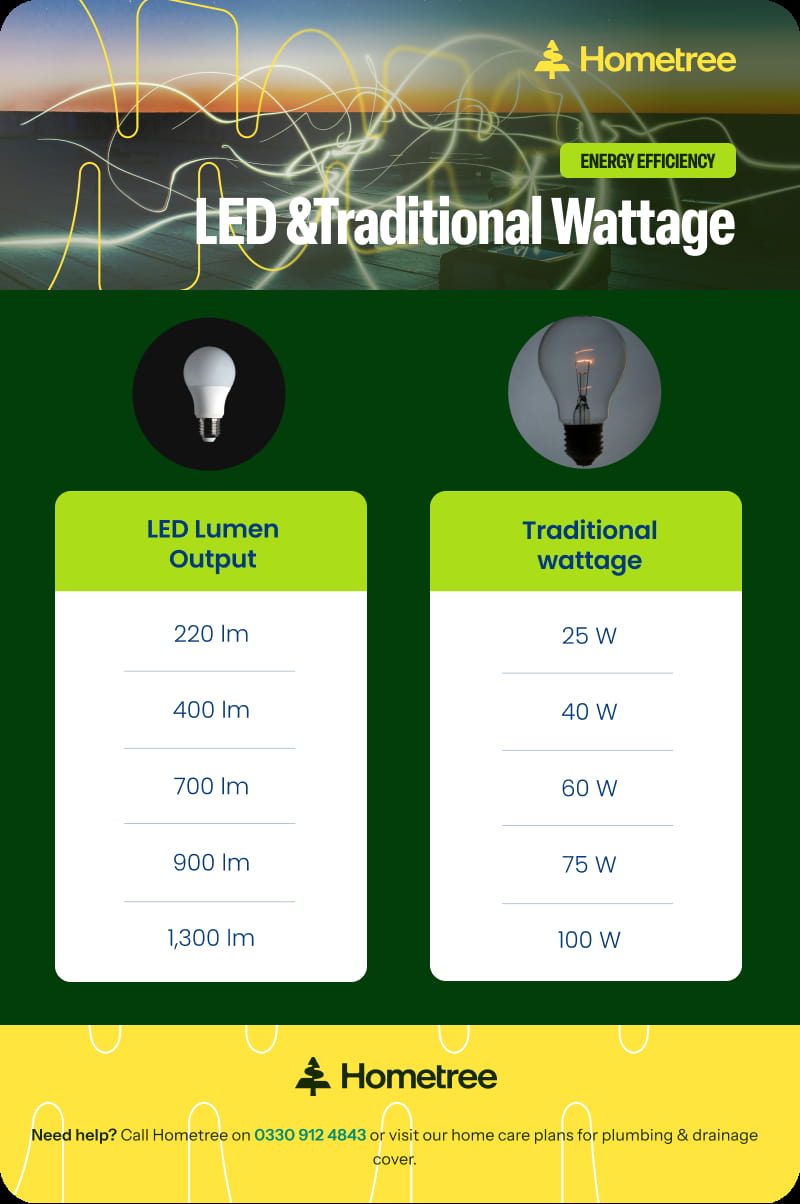
For example, a highly efficient 6-watt LED can emit the exact same light output as a traditional 40-watt incandescent bulb.
Use the following table to match the brightness you need:
Warm vs cool light
The colour of your light bulb depends on your personal preference.
For cosy living spaces, people often prefer soft or warm white bulbs. And for more practical rooms (garages, kitchens, or workspaces), opt for cool or pure white bulbs.
If colour accuracy matters in your room, look for bulbs with a high Colour Rendering Index (CRI).
Cheap, low-end cool-white LEDs can sometimes make objects look unnatural.
They have a sharp blue spike at 460 nanometres and a deep dip at 500 nanometres, which is very different from natural sunlight.
Are energy-saving light bulbs worth the switch?
Undeniably. Low-energy bulbs cost slightly more than traditional bulbs upfront, but they quickly pay for themselves. They consume less electricity. And they last for over a decade.
Pairing efficient lighting with other home management solutions (such as smart meters and quality home insulation) is a great way to save home energy.
Further reading: 10 Home Energy Myths Debunked
Get your home appliances covered with Hometree
Note: Our home electrical and appliance cover do not cover lightbulbs.
Our home electrical cover includes unlimited repairs, an annual boiler service, zero parts & labour charges, and 24/7 claims support to keep your home warm. Subject to exclusions and T&Cs apply.
With no hidden fees and coverage across England, Scotland, and Wales, we’ve got you covered.
You can get covered today or contact us for a free quote.


We Beat or Match Any Quote
Phone us to beat or match British Gas or Homeserve quotes, Terms apply.

Serious About Service
24/7 claims support & rated Excellent on Trustpilot

Cover Match Guarantee
£50 gift card if we don’t cover something British Gas or Homeserve do, terms apply

All Gas Boilers Covered
All makes and models, regardless of age