Energy Performance Certificates (EPCs): Oct 2026 Overhaul, Retrofits & Landlord Compliance

Energy Performance Certificates (EPCs) are far more than just administrative paperwork.
Their goal is to serve as blueprints for:
- Slashing energy bills
- Making homes more comfortable
- Protecting the environment.
A strong rating can also boost your property’s market value.
But the landscape of home energy is changing. With a major regulatory overhaul coming in October 2026, alongside net-zero goals, keeping up with EPC standards is no longer optional.
EPCs: An overview
An EPC is a standardised four-page document that records the measurements of a building’s overall energy efficiency.
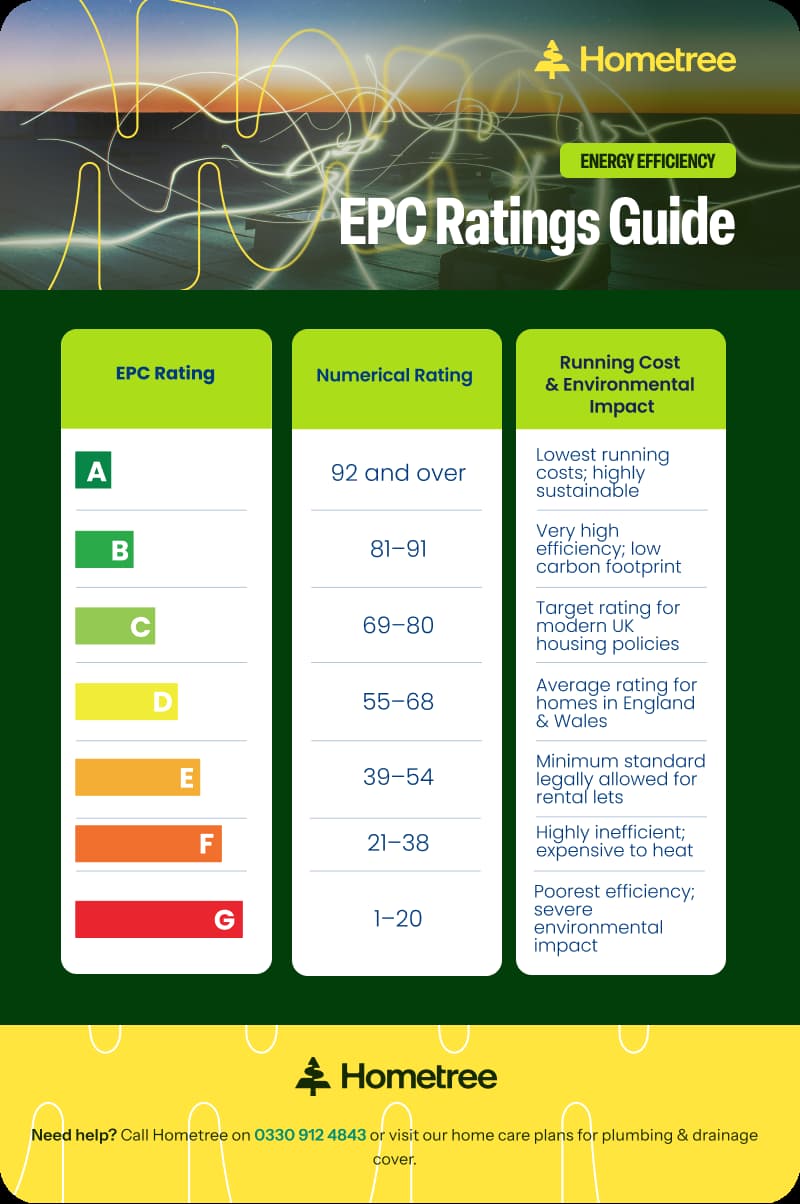
It uses a colour-coded alphabetical rating system ranging from A (extremely efficient, cheap to run) to G (highly inefficient, expensive to run, and environmentally damaging).
Every certificate displays both a property’s current energy score and its potential one. It includes recommendations for achieving the latter.
All residential EPCs carry an alphabetical band and a corresponding numerical score:
EPC validity, costs & compliance
Since 2008, an EPC has been a legal requirement for new property constructions, sales, and lettings.
Once issued by a certified assessor, it’s valid for 10 years. Not having a valid EPC when selling or letting a residential property can result in a fixed penalty of £200 per property.
You can search for any property’s existing EPC — or find a local accredited assessor — at the government’s ‘Find an Energy Certificate service’.
What EPC assessments involve
EPC assessments are carried out by certified domestic energy assessors. Most homeowners pay between £60 and £150, depending on the property’s size and location.
During the visit, the assessor will evaluate a range of factors, including:
- The property’s size, construction type, and age
- The primary heating system and its efficiency rating
- Wall, floor, and loft insulation levels
- Window glazing type (single, double, or triple)
- Renewable energy sources (such as solar panels)
- Lighting and ventilation systems
Once the assessment is complete, you’ll receive your certificate within a few days. It will detail both your current rating and your potential score, along with specific recommendations for improvement.
The October 2026 overhaul: Introducing the four-metric scorecard
Property energy evaluations in England and Wales are set to change. The current system’s reliance on a single, aggregated headline rating will be replaced in October 2026 by a four-metric scorecard.
The new system will assess and score separately on four distinct pillars:
- Fabric performance: This measures the pure thermal efficiency of your property’s physical shell. It evaluates how effectively your walls, roof, doors, and floors trap heat inside the building
- Heating system: Rather than blending heating with other factors, assessors will isolate your heating source, scoring it directly on its operational efficiency and carbon output
- Energy cost: This reflects the actual costs of heating the property under standard usage
- Smart readiness: A metric evaluating your home’s infrastructure for integrating smart home automation, smart thermostats, and active load-balancing technologies.
Vanishing exemptions
Historically, blanket exemptions from EPC requirements applied to:
- Heritage and listed properties
- Short-term holiday lets
- Houses in Multiple Occupation (HMOs) where individual rooms are rented out.
Under the upcoming changes, these will now all require valid certificates.
Expert perspectives: Is the EPC system fit for purpose?
Governments and large-scale developers often rely heavily on EPCs to anchor their decarbonisation targets.
For example, the housing provider Together Housing has a 15-year strategy to bring 37,000 properties up to Band C by 2030.
However, some energy experts debate whether the certificates are truly reliable.
The home health and surveyor view
Qualified Surveyor Jason Ratcliffe, host of the Heal Your Home podcast, argues that we must look beyond basic legal compliance.
An EPC provides a snapshot of energy loss, he says, but it doesn’t measure “home health”, which includes factors that keep residents safe like ventilation, damp mitigation, and indoor air quality.
Property Director Rob Graves notes, however, that energy efficiency is increasingly tied to real asset value. Buyers actively seek homes insulated from energy market shocks.
The consumer advocacy view
Gareth Shaw and Jenny Ross of Which? have raised concerns about the consistency of assessments.
And sustainability specialist Karen Lawrence reports that field tests comparing energy advice often give inaccurate reports from poorly trained assessors. There is a need for improving regulatory and professional standards.
The smarter retrofit view
Broadcaster Phil Spencer and David Sanders of Vibrant Energy Matters argue that traditional EPCs have outgrown their original purpose.
They suggest that whilst an EPC is a useful bare minimum, homeowners planning a true transition should seek a VESA (Vibrant Energy Assessment) Report. This is an in-depth bespoke diagnostic for retrofitting older buildings.
The policy and transition realists
Energy consultant Kathryn Porter warns that aggressive, top-down transition policies must balance renewable aspirations with hydrocarbon realities.
Otherwise, they risk placing an unviable, regressive financial burden on the average homeowner.
Meanwhile, Stuart Fairlie and Keeran Jugdoyal of the Department for Levelling Up, Housing and Communities (DLUHC) maintain that EPCs remain an indispensable macroeconomic lever to drive the UK’s net-zero transition.
These perspectives share a consensus that the EPC, while imperfect, remains the primary lever for driving home energy standards in the UK.
And that the October 2026 overhaul represents an overdue evolution rather than a wholesale revolution.
How to improve your property’s score
The average energy rating for properties in England and Wales currently sits at a Band D.
However, in an era of volatile energy markets, properties with higher ratings are securing significantly more attention.
If you want to raise your home’s EPC rating to secure lower energy bills or prepare for future sale, you should prioritise your property’s ‘shell’ before spending thousands on highly complex heating technologies.
Maximise your insulation
Loft insulation is the most cost-effective and highest-yielding “quick win” for raising your score. And wall and floor insulation is crucial for trapping heat but typically requires specialist installation and support.
Upgrade your glazing
Single-glazed windows are massive escape routes for domestic heat. Upgrading to double glazing (ideal for suburban areas) or triple glazing (the gold standard for acoustic and thermal barrier performance) makes a big difference.
If you already have double glazing, ensure draft-sealing and window frames are fully intact.
Upgrade your primary boiler
Ageing, non-condensing gas boilers suffer from substantial fuel waste. Modern condensing boilers — whether combi, system, or regular — feature specialised heat-exchangers.
These capture waste heat from flue gases and drive fuel efficiency up to 90%.
Consider renewable technology
Installing solar panels is one of the single most effective ways to elevate an EPC score while insulating yourself from grid price spikes.
Alternatively, heat pumps provide highly sustainable, low-carbon heating and cooling, although they work best in homes that are already well-insulated.
Assessor top tip: Recent government software updates have automatically bumped some properties up into a Band C rating. So, before spending money on major renovations, have your property reassessed under the latest software — you might already be compliant.
A caveat: the rebound effect
Before setting your savings expectations, it’s worth understanding a well-documented economic pattern.
When heating becomes more efficient, it also becomes cheaper per hour. And when it becomes cheaper, most households use more of it.
For example, they may start turning the thermostat up, heating rooms previously left cold, extending heating hours into the evening, etc.
Economists call this the rebound effect, and it explains why real-world energy savings often fall short of the theoretical figures on an EPC.
On an individual level, you will still save. But it’s likely it will be less than the projected figure suggests. Factor this into your retrofit ROI calculations rather than treating the headline savings as guaranteed.
What private landlords need to know
If you are a private landlord, EPC ratings are not just a tool for saving money. They are part of a landlord’s responsibilities.
1. The 2030 band C mandate & the £10,000 cap
The government has mandated that all privately rented properties in England and Wales must reach an EPC rating of C by 2030.
However, to prevent undue financial hardship, this rule is paired with a £10,000 spending cap per property.
If you spend up to £10,000 on recommended energy upgrades and the property still fails to hit Band C, you can legally register an exemption.
2. Section 11 and Awaab’s Law Phase 2
Under Section 11 of the Landlord and Tenant Act 1985, you are legally responsible for maintaining the structural exterior and all heating, water, gas, and electrical installations of your rental property.
This is a non-negotiable statutory duty, and its costs cannot be passed to the tenant.
This duty is reinforced by Awaab’s Law Phase 2, which officially takes effect on 30 November 2026. This legislation extends strict, legally binding emergency repair timescales to private tenancies, specifically covering excess cold, fire, and electrical hazards.
The 24-Hour Rule
If a heating system fails during cold winter weather, it is legally classified as an emergency hazard posing an immediate risk to health.
You must have a competent person investigate and make the hazard safe within 24 hours of the tenant reporting it.
The consequences
Missing these deadlines can lead to severe penalties, banning orders, and tenant-paid Ombudsman awards of up to £25,000.
Additionally, under the “alternative accommodation” clause, if you cannot remediate the heating failure within 24 hours, you must pay for suitable alternative accommodation for your tenants at your own expense.
3. Proving your upgrades
One critical piece of advice for landlords is to document everything.
Under the upcoming rules, the assessor must discount the work if a landlord cannot provide any of the following:
- Provide clear photographic evidence
- Official material specifications
- Formal contractor invoices for hidden upgrades (like underfloor or cavity wall insulation).
In other words, these items will not exist in the eyes of the EPC assessment without evidence.
4. The value of boiler cover and servicing
Landlords frequently confuse an annual Gas Safety Check (CP12) with a full boiler service.
A CP12 simply confirms the system is safe to turn on. And a boiler service involves checking and cleaning internal components to prevent mid-winter breakdowns.
A proactive boiler service costs between £80 and £120.
In contrast, emergency out-of-hours call-outs can easily exceed £300, and a complete boiler replacement runs between £1,500 and £3,000.
The bottom line
Whether you are a homeowner seeking a warmer, cheaper house, or a landlord managing legal compliance, Energy Performance Certificates are the ultimate roadmap.
By pairing a proactive “fabric-first” insulation strategy with smart heating maintenance, you can protect your property’s value, lower your overheads, and secure complete peace of mind.
Get your central heating covered with Hometree
Our central heating cover includes unlimited repairs, an annual boiler service, zero parts & labour charges, and 24/7 claims support to keep your home warm. Subject to exclusions and T&Cs apply.
With no hidden fees and coverage across England, Scotland, and Wales, we’ve got you covered.
You can get covered today or contact us for a free quote.

We Beat or Match Any Quote
Phone us to beat or match British Gas or Homeserve quotes, Terms apply.

Serious About Service
24/7 claims support & rated Excellent on Trustpilot

Cover Match Guarantee
£50 gift card if we don’t cover something British Gas or Homeserve do, terms apply

All Gas Boilers Covered
All makes and models, regardless of age