What is a Landlord Gas Safety Record (LGSR) and CP12?

In the UK, landlords have several responsibilities.
One of the key regulatory frameworks is the Landlord Gas Safety Record (LGSR).
But what exactly is an LGSR, what does a check cost, and how does it protect both your tenants and your business?
More importantly, how does it connect to major new legal standards like Awaab’s Law?
Here is everything UK landlords need to know.
Brief background: From CORGI to Gas Safe Register
The Landlord Gas Safety Record (LGSR), also commonly referred to as a CP12 certificate or simply a Gas Safety Certificate, is the result of decades of UK gas safety standards.
The main UK body for gas safety, the Council for Registered Gas Installers (CORGI), was founded in 1970, partly as response to a 1968 gas explosion in a London towerblock.
They issued CORGI Performa 12 certificates, which were a legal requirement between 1991 and 2009.
The Gas Safe Register officially took over from CORGI as the legally mandated body for gas safety in the UK in 2009.
While the official legislative name is now the Landlord Gas Safety Record (LGSR), the old “CP12” shorthand has stuck around in the industry.
LGSR costs
If you don’t have landlord boiler cover, a standalone Gas Safety check typically costs in the region of £60 to £100 per property.
This price can vary depending on your location and the number of gas appliances that need to be checked. For example, London and the Southeast are generally more expensive.
Members of landlord associations can often access discounted rates of around £70 through the associations’ partners.
LGSR timeframes
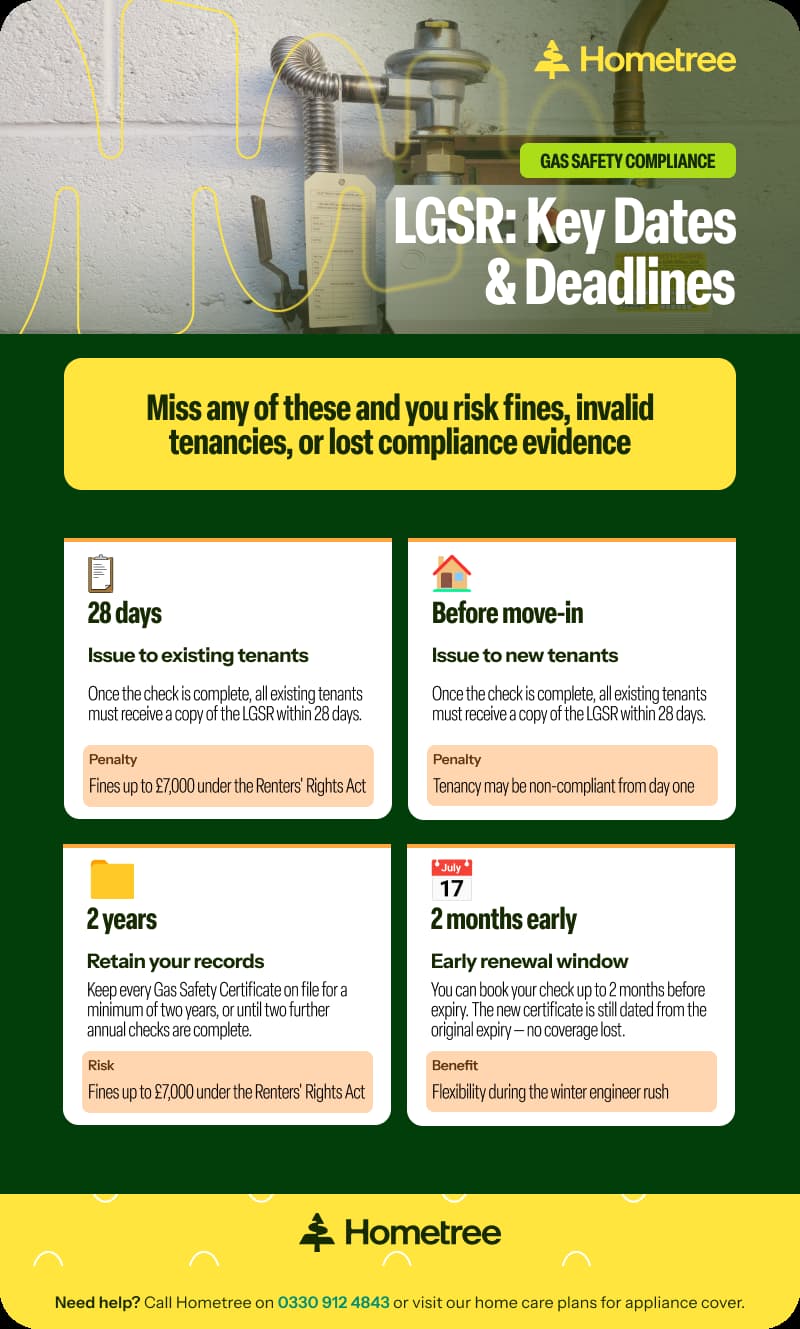
The exact duration of the physical inspection is not explicitly detailed in standard legislation guides. It depends on the number of gas appliances and the complexity of a property’s flues.
A qualified Gas Safe registered engineer must test every appliance individually. A quick visual check alone is insufficient (and illegal).
Awaab’s Law: The new 24-hour emergency trigger
Keeping your gas safety records and central heating systems in good condition helps you navigate Awaab’s Law.
Phase 1 of Awaab’s Law applied these strict rules only to social housing.
Phase 2 comes into force on 30 November 2026, but it’s also a social housing measure. It expands the range of hazards social landlords must respond to within the same strict timescales, including:
- Excess cold and heat
- Fire
- Electrical risks.
It does not yet bring private landlords into scope.
The Renters’ Rights Act 2025 commitment
However, The Renters’ Rights Act does commit to extending Awaab’s Law to private rented homes in future. But no implementation date has been confirmed for private landlords.
Once it does apply, it gives landlords heating obligations in emergencies. A complete gas heating or hot water failure during cold weather will likely be treated as an emergency hazard. This will require landlords to:
- Investigate and make the hazard safe within 24 hours
- Begin permanent remediation work within 7 days.
Arranging alternative accomodation
Under the current social housing rules, if a landlord fails to fix the hazard, or make it safe, within that initial 24-hour window, they must secure alternative accommodation for tenants. This could be a hotel or short-term let.
Having a current LGSR and an active annual service is good practice regardless of when private sector rules land. It provides evidence of compliance ahead of that extension.
A well-serviced boiler is also less likely to breakdown during the winter peak.
What needs to be checked: The Regulation 36 Checklist
Under Regulation 36 of the Gas Safety (Installation and Use) Regulations 1998 (GSIUR), an engineer must carry out the following checks to issue a valid LGSR:
- Visual inspection of the gas installation, appliance location, terminal, chimney/flue route, and checking for signs of incomplete combustion
- Appliance operating pressure and/or heat input to ensure the boiler burns gas correctly
- Ventilation check to confirm that vents are clear, clean, and sized correctly.
- Flue flow and spillage testing to ensure harmful combustion gases discharge safely outside
- Safety controls and flame supervision devices must be tested for correct operation
- Investigation of any evidence of unsafe operation.
When the tenant owns the gas appliances
As a landlord, you are only legally responsible for checking and maintaining the gas appliances and flues that you have provided. Tenants are responsible for any gas cookers or heaters they bring to your property.
However, do note that you are fully responsible for the gas pipework and the flue system that their appliance connects to.
Record-keeping & the Renters’ Rights Act 2025
Securing the certificate is only part of a landlords’ work. Managing the paperwork is also critical.
The 28-day rule
You must provide existing tenants with a copy of the completed LGSR within 28 days of the check being done.
Pre-tenancy checks
New tenants must receive a copy of the current valid certificate before they can legally move into the property.
Retaining records
You must keep every Gas Safety Certificate on file for a minimum of two years (or until two further annual checks have been completed).
Fines under the Renters’ Rights Act 2025
Under the Renters’ Rights Act, new assured periodic agreements created on or after 1st May 2026 must contain detailed information about your obligations as a landlord. This includes gas safety.
Failing to provide this written statement with the required compliance details to the tenant can result in local authority fines of up to £7,000.
How landlord boiler cover helps with compliance
Landlord plans can help you track renewal dates, quickly find Gas Safe engineers during the winter rush, and respond to sudden heating emergencies within the Awaab’s Law 24-hour limit.
They can also take care of annual inspections and issuing your LGSR.
Get landlord boiler cover with Hometree
Our landlord boiler cover includes unlimited repairs, an annual boiler service, zero parts & labour charges, and 24/7 claims support to keep your home warm. Subject to exclusions and T&Cs apply.
With no hidden fees and coverage across England, Scotland, and Wales, we’ve got you covered.
You can get covered today or contact us for a free quote.


We Beat or Match Any Quote
Phone us to beat or match British Gas or Homeserve quotes, Terms apply.

Serious About Service
24/7 claims support & rated Excellent on Trustpilot

Cover Match Guarantee
£50 gift card if we don’t cover something British Gas or Homeserve do, terms apply

All Gas Boilers Covered
All makes and models, regardless of age