Boiler Not Working? Potential Causes (& Fixes)

When a boiler stops working, most people do one or both of the following: panic or immediately call an engineer.
Often, neither is necessary.
Most emergency boiler callouts turn out to have a simple fix.
Before you pick up the phone, it’s worth running through a few basic checks.
These could save you time and money!
Below, we’ve covered:
- The most common boiler problems
- Their causes
- What to try first.
Important pre-amble: Why engineers matter!
Diagnosing a boiler fault is not often as simple as changing a lightbulb. Sometimes it’s more like a medical consultation or detective work.
Experienced engineers will tell you it takes around five years of study and experience in the field to truly be confident handling whatever a boiler throws at you.
An engineer will sometimes tell you that your boiler can’t be switched back on. This is because running it wouldn’t be safe, not because they can’t fix it.
That’s exactly the judgement you’re paying for.
The engineer who gives you an honest answer is doing their job properly. The one who gets it running at any cost and leaves quickly is the one to be wary of.
So by all means, work through the checks in this guide — many problems are simpler than they appear.
But if something doesn’t feel right, trust the process and call a professional.
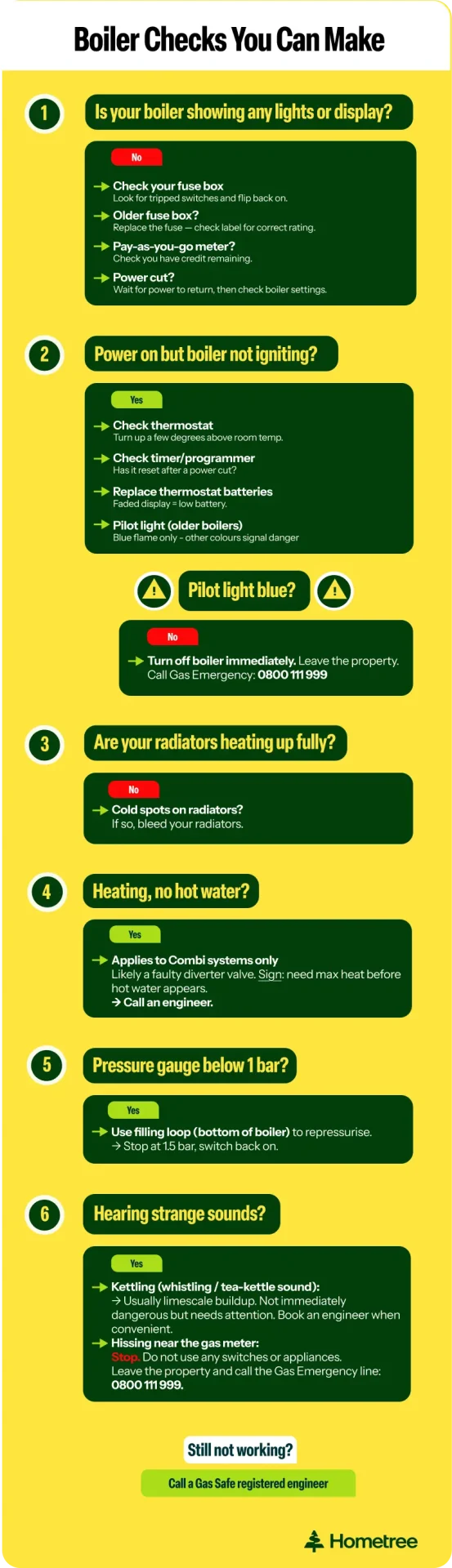
1. No power to boiler
If there’s no power to your boiler, an electrical fault is likely to blame.
The good news is this is usually easy to fix, so you won’t have a broken boiler for long.
Potential cause: A power cut
If you’ve had a power cut, everything connected to electricity will shut down in your home. It will likely have affected your neighbours, too.
Potential fix: Reset
There’s not much you can do at this point. But it’s worth checking your boiler’s dashboard when it comes back on to see if the previous settings have been saved or reset.
Potential cause: A fuse in the boiler has blown
All types of boilers are fitted with fuses to prevent electrical surges from damaging internal components.
If your fuse box has tripped, power in part of your home will have cut. If your boiler is on the same circuit, it will be affected, too.
Potential fix: Reset
Head to your fuse box and see if any of the switches have turned off.
If it’s an older fuse box, you will need to change a fuse. Refer to your fuse box label or manufacturer guidance for the correct fuse rating.
If it’s a newer fuse box (known as a consumer unit), you will likely just need to turn a switch back on.
Potential fix: Top up
Still having trouble? If you’re on a pay-as-you-go electric meter, it’s worth checking to see if it’s run out of credit.
If your meter does have credit and your boiler still won’t work, there’s a chance there could be a problem with the meter.
Rather than ringing a gas engineer, your best bet is to phone your utility company. Most electric meters are digital so they should be able to resolve the issue over the phone.
2. Boiler power on but it’s not igniting
Perhaps your boiler’s dashboard and other lights are on, but it’s not heating up.
There are several potential causes of a boiler not igniting.
Potential cause: Thermostat and timer issues
If your fuse box tripped or you had a power cut recently, your thermostat and timer might have reset.
Potential fix: Reset
Check the times on any timers and thermostats you use to make sure they’re correct. You may need to reprogram them if they’ve lost your previous settings.
If they look fine, try turning the thermostat up a few degrees above the current room temperature and see if the boiler kicks in. If it does, they are working fine.
Potential fix: Replace batteries
If your thermostat is battery-operated (not all are), you may find that they simply need changing. If the battery is low, the LED screen will have faded or missing some information.
Changing thermostat batteries is usually very straightforward. Simply remove the front cover and swap the old for new. Most take 2x AA or 2x AAA batteries.
Potential fix: Upgrade controller
Old thermostat models (especially ones over 15 years old) sometimes misread settings and misjudge room temperatures. This could be why your heating may be turning on and off at the wrong times.
Install a new thermostat. You might be able to do this yourself with some models. Others require engineers.
Either way, it will likely improve your boiler’s efficiency and lower your energy costs.
Potential fix: Change thermostat location
Thermostat’s installed next to a heat source (i.e. radiator), or too close to a draught (i.e. window), can cause problems.
Re-installing your thermostat in a better location will greatly improve its accuracy.
Potential cause: Pilot light issues
A pilot light is the flame that heats gas to warm your boiler. They are an issue for older boilers (newer ones don’t have them).
If your pilot light has gone out, you might be able to reset it yourself by following your manufacturer’s instructions.
If it is igniting but is any colour except blue, you should turn off your boiler immediately and contact a registered Gas Safe engineer.
It could be producing carbon monoxide, an odourless and potentially fatal poisonous gas.
Potential cause: Gas supply issue
Gas valves can be disrupted by blockages, damage, or simply by being turned off.
In most cases, boilers will shut down to reduce the risks of receiving too much or too little gas.
One way to check if this is an issue is to see if other gas-run appliances are working, such as the ovens or gas fireplaces.
Potential fix: Call an engineer!
Gas valve repairs require the expertise of Gas Safe registered engineers.
3. Radiators not heating up
If your radiators don’t appear to be heating up properly or you can feel cold spots, your boiler might not be the issue.
The fix could be as simple as bleeding your radiators.
Potential fix: Bleeding a radiator
All you need is a radiator key and a bucket or towel to catch any dribbles of water.
- Turn off your central heating to allow your radiators to cool
- Insert the radiator key into the radiator valve. Gently turn it anticlockwise, with a cloth or bucket underneath to catch any water
- Listen for a hissing noise. This will be the air escaping
- Once water emerges, quickly close the valve
- Turn the radiator valve clockwise to close it.
Removing the trapped air from your radiators should enable them to heat up fully. Turn your heating back on to check.
4. Have heating but no hot water (Combi systems only)
If your central heating is working properly but you’ve not got any hot water, it’s likely there’s a problem with the diverter valve.
This is the component on combi systems that allows them to switch between heating and hot water.
If you’re not getting any hot water, the valve is likely stuck in the central heating position or has experienced a fault.
A sign of this will be needing to turn your central heating up to its maximum before you get any hot water.
Potential fix: Call an engineer!
Unfortunately, a faulty diverter valve is not something you can fix yourself.
However, at least you will be able to tell your boiler cover provider or gas engineer exactly what the problem is.
And if you have boiler cover, you can claim the cost of the replacement valve and labour.
5. Is your boiler pressure right?
Low boiler pressure is a common issue, especially with combi systems.
Luckily, it’s fairly easy to fix yourself.
Potential fix: reduce pressure
Access your boiler control panel and examine the pressure gauge or dial. It should be set at between 1 – 1.5 bars (if it’s any lower, your boiler won’t work properly).
- First, make sure the boiler is turned off
- Increase boiler pressure using the filling loop. This is located at the bottom of the boiler
- Check the ends of the hoses are attached to the valves so there aren’t leaks.
- Open the valves and you should hear water filling up the system. Watch pressure gauge and when it reaches 1.5 close the valves
- Now, switch the boiler back on.
If the boiler problem was caused by a lack of pressure, this should solve it.
6. Hearing strange sounds?
Strange boiler noises can often signal underlying mechanical issues or safety risks.
While some sounds are minor, others require immediate professional attention to maintain efficiency and safety.
Key examples include:
- Hissing: Often caused by pressure issues or leaks. If heard near the gas meter, it may indicate a dangerous gas leak.
- Kettling: A whistling sound similar to a tea kettle, usually caused by limescale buildup or trapped steam.
Because boilers are complex and potentially hazardous, you should always consult a Gas Safe engineer for an accurate diagnosis.
Still can’t get your boiler working?
Read our guide on how to deal with a broken boiler.
Get your boiler covered with Hometree
Our boiler cover includes unlimited repairs, an annual boiler service, zero parts & labour charges, and 24/7 claims support to keep your home warm. Subject to exclusions and T&Cs apply.


Get a fixed price boiler repair for £90

We Beat or Match Any Quote
Phone us to beat or match British Gas or Homeserve quotes, Terms apply.

Serious About Service
24/7 claims support & rated Excellent on Trustpilot

Cover Match Guarantee
£50 gift card if we don’t cover something British Gas or Homeserve do, terms apply

All Gas Boilers Covered
All makes and models, regardless of age