Boiler Noises Explained (Including Audio Examples)

Most do not check their boiler often.
But when it makes strange noises, you may have to…
Boilers are complex systems, and whilst some sounds indicate minor issues, others could be serious.
After all, faulty boilers can reduce heating efficiency, increase your bills, and – in extreme situations – put people at risk.
If your boiler is making unusual noises, this guide will help you understand what the sounds mean, how dangerous they are, and what action you need to take.
Important: Always consult a Gas Safe registered engineer for a professional evaluation before attempting any internal repairs.
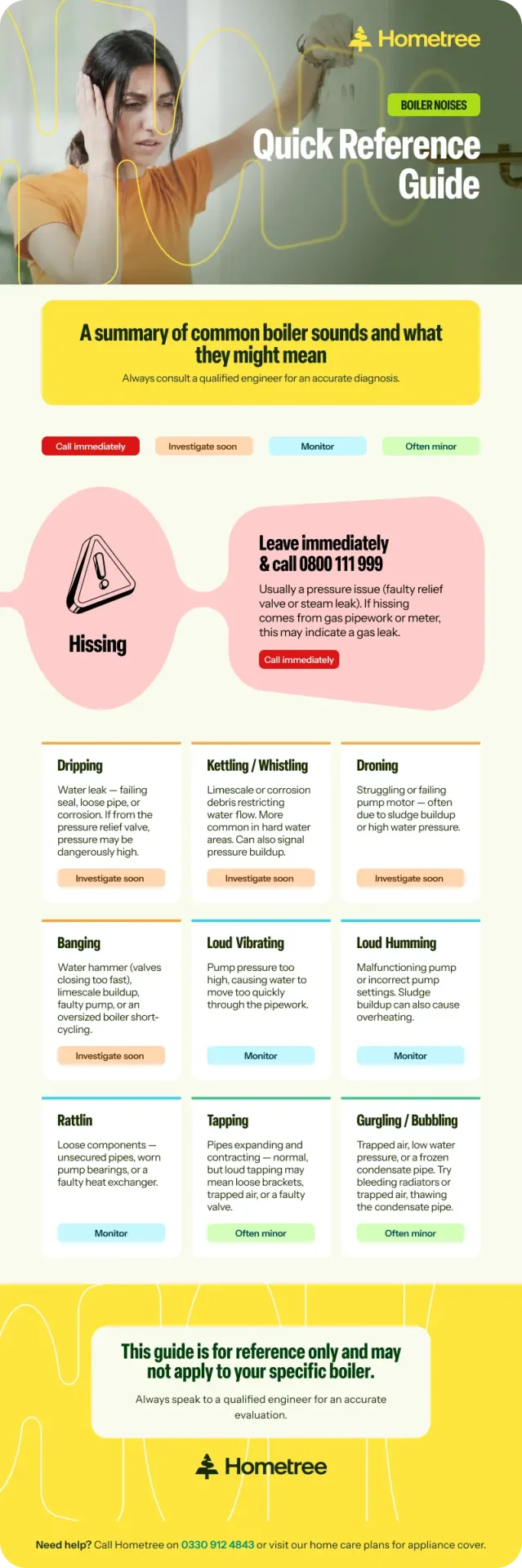
Note: We’ve amplified some of the sound recordings for illustrative purposes.
1. Hissing
Potential cause(/s)
Hissing from a boiler usually means there is a pressure issue. It’s often caused by a faulty pressure relief valve or a steam leak from a broken seal.
Danger level: Moderate to high
If the hissing is coming from the boiler itself, it requires an inspection as soon as possible to prevent water damage or system failure.
However, if you hear hissing from your gas pipework or meter, this indicates a potential gas leak.
This is extremely dangerous.
You must leave the property immediately, avoid using any electrical switches, and call the National Gas Emergency line on 0800 111 999.
2. Rattling
Potential cause(/s)
A rattling noise is commonly caused by loose components inside or around the boiler casing.
It often points to unsecured pipes knocking against a wall or fixtures, a worn pump bearing, or a faulty heat exchanger.
Danger level: Low
A rattle is rarely dangerous. However, ignoring it can cause minor faults to escalate into expensive component damage. It’s worth having an engineer inspect and secure the loose parts..
3. Dripping
Potential cause(/s)
Dripping sounds usually signal that your boiler is leaking water internally or externally.
Common culprits include:
- A failing rubber seal
- A loose pipe connection
- Slow corrosion of pipework.
If water is dripping specifically from the pressure relief valve, your boiler is likely operating at too high a pressure.
Danger level: Moderate
Water leaks can drip onto delicate electrical circuit boards, causing a complete system short-circuit.
High pressure also strains the entire system and must be assessed by a professional as soon as possible.
4. Tapping
Potential cause(/s)
Tapping noises are most commonly caused by heating pipes expanding and contracting as they heat up and cool down.
This is a completely normal part of how a central heating system operates.
However, loose pipe brackets or trapped air can make these taps louder.
Danger level: Low
Tapping is usually normal. If it’s persistent and frustrating, you (or an engineer) can tighten your pipe clips or bleed the system to quieten it down.
5. Droning
Potential cause(/s)
A droning boiler is often a sign of a struggling or failing pump motor.
This can happen if the pump has partially seized or is working harder than it should due to a build-up of magnetic metallic sludge.
High water pressure can also produce a persistent droning sound.
Danger level: Moderate
While not physically hazardous to your home, a struggling pump will reduce your heating efficiency and could burn out completely, leaving you without hot water.
6. Banging
Potential cause(/s)
Banging noises are most commonly caused by water hammer. This occurs when valves close too quickly, which interrupts water flow.
It can also be caused by limescale build-up on the heat exchanger, causing steam pockets to appear that collapse abruptly.
Less commonly, an oversized boiler can cause short-cycling, a rapid firing and shutting down which causes banging sounds.
Danger level: Moderate
Persistent water hammer or severe short-cycling can damage pipework joints and internal boiler components over time.
7. Kettling or whistling
Potential cause(/s)
If your boiler sounds like a boiling kettle, it is experiencing “kettling”, characterised by whistling, rumbling, and/or bubbling sounds.
This happens when limescale or corrosion debris builds up around the heat exchanger, restricting water flow.
The trapped water overheats, boils, and turns to steam, which makes a whistling sound.
Danger level: Moderate to high
Kettling is a sign of localised overheating and pressure build-up.
It severely reduces boiler efficiency, and can permanently damage the heat exchanger if not fixed.
8. Loud vibrating
Potential cause(/s)
Loud vibrations are usually caused by loose casing screws or a loose boiler mounting bracket.
It can also occur if the pump’s speed or pressure is set too high, forcing heated water to travel too quickly around the pipework.
Danger level: Low to moderate
Vibrating brackets are harmless, but high water velocity from incorrect pump settings can put unnecessary stress on your pipe joints.
Tightening loose brackets is a quick DIY fix, but a pump adjustment requires an expert.
9. Loud humming
Potential cause(/s)
Humming typically indicates a malfunctioning central heating pump or incorrect pump speed settings.
Overheating caused by a heavy build-up of sludge inside the boiler can also trigger a loud hum.
Danger level: Low to moderate
A strained pump is not immediately dangerous.
If the hum is loud or accompanied by a high-pitched whine, your pump may be close to failing. And whilst this will leave you without heating (and may cause a safe boiler lockdown), it’s not a safety risk.
10. Gurgling/bubbling
Potential cause(/s)
Gurgling is almost always caused by one of the following:
- Trapped air in the heating system
- Low water pressure
- A frozen condensate pipe.
11. Buzzing
Potential cause(/s)
Buzzing can indicate a range of potential causes, including:
- A faulty electrical component
- A failing pump
- Loose internal components
- Air trapped inside the pump.
Danger level: Low to moderate
While a vibrating casing is harmless, an electrical buzz could mean a failing circuit board or solenoid valve. So, it’s best to have a Gas Safe engineer inspect the electrical connections.
12. Rumbling
Potential cause(/s)
A low rumbling (or a deep bass) noise is typically a sign of early-stage kettling or heavy sludge accumulation at the bottom of the boiler.
Sludge blocks heat transfer, causing water to boil locally and create low-frequency rumbling pockets of steam.
Danger level: Moderate
Rumbling means your boiler is working much harder than necessary, which inflates your monthly energy bills. Over time, this sludge will corrode and ruin your heat exchanger.
13. Noise like a washing machine
Potential cause(/s)
If your boiler sounds like a washing machine on a spin cycle, the issue is almost always a failing pump bearing or a compromised flue fan.
Danger level: Moderate
A fan running at high speed or a pump with worn bearings is under strain.
If either component fails completely, the boiler will shut down for safety.
Get your boiler covered with Hometree
Our boiler cover includes unlimited repairs, an annual boiler service, zero parts & labour charges, and 24/7 claims support to keep your home warm. Subject to exclusions and T&Cs apply.
With no hidden fees and coverage across England, Scotland, and Wales, we’ve got you covered.
You can get covered today or contact us for a free quote.
Frequently asked questions
Why is my boiler making noise when switched off or not in use?
When your boiler is turned off, the central heating pipes naturally cool down and contract, which can create clicking or tapping sounds.
Additionally, a gurgling sound after shutdown is often just the remaining condensate water dripping down the drain, or the pump running a brief post-circulation cycle to safely dissipate residual heat.
Why is my boiler making noise when the heating or hot water is on?
When the heating or hot water is active, the boiler is burning fuel and actively pumping water around your home.
If there is trapped air, high water pressure, or a build-up of limescale in the system, the rapid movement of water and heat will cause expansion, gurgling, or humming.
Is boiler kettling dangerous?
Boiler kettling is not immediately life-threatening, but it is a serious issue that should not be ignored.


Get a fixed price boiler repair for £90

We Beat or Match Any Quote
Phone us to beat or match British Gas or Homeserve quotes, Terms apply.

Serious About Service
24/7 claims support & rated Excellent on Trustpilot

Cover Match Guarantee
£50 gift card if we don’t cover something British Gas or Homeserve do, terms apply

All Gas Boilers Covered
All makes and models, regardless of age