25 Ways to Save Energy at Home: UK Guide

UK energy bills are highly exposed to global markets.
And because of marginal pricing in our power markets, expensive gas—often imported as Liquified Natural Gas (LNG)—frequently sets the baseline wholesale price for all electricity on our grid.
Without rapid network upgrades, annual costs to balance the electricity grid and manage congestion are projected to nearly quadruple.
This means a climb from a recent baseline of around £2 billion to a staggering £8 billion a year by 2030, according to the National Energy System Operator (NESO).
However, you do not have to be at the total mercy of the market. Small daily adjustments can still make a real impact on your utility bills.
Heating and radiator controls
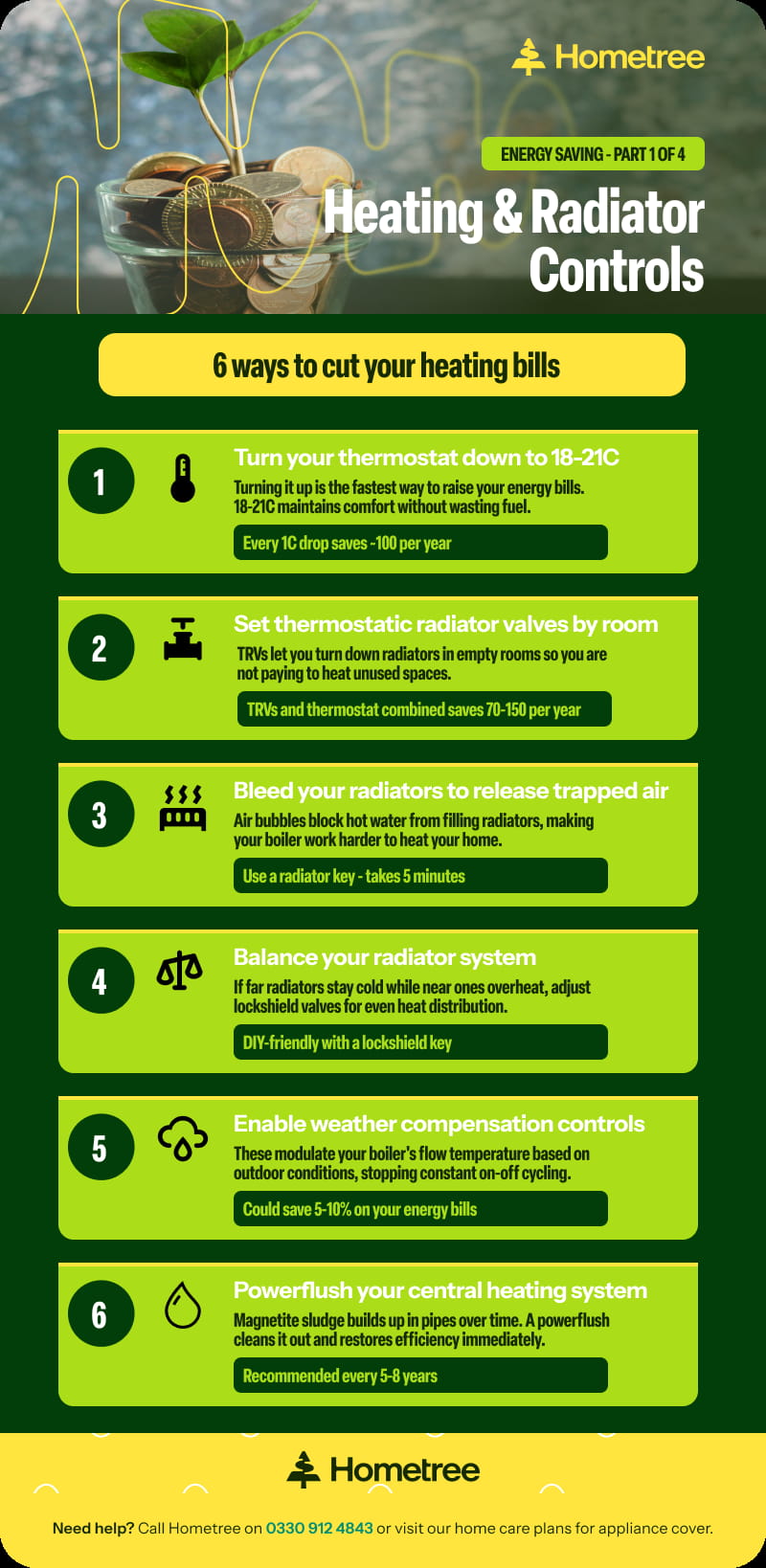
1. Turn down your thermostat to 18–21°C
Turning up your thermostat is the fastest way to raise your energy bills.
Keep your home between 18°C and 21°C to maintain a comfort and not waste fuel.
2. Set thermostatic radiator valves by room type
Thermostatic radiator valves (TRVs) give you individual room comfort. You can turn down radiators in empty rooms so you are not paying to heat unused spaces.
And installing TRVs and a thermostat could save you £70 to £150 a year.
3. Bleed your radiators to release trapped air
Air bubbles can become trapped at the top of your radiators, blocking hot water from filling them. This makes your boiler work harder to heat your home.
Bleeding your radiators releases this air and restores full heat distribution.
4. Balance your radiator system
If radiators furthest from your boiler stay cold while closer ones get hot, your system is unbalanced.
Balancing your radiators involves adjusting the lockshield valves to ensure hot water distributes evenly.
5. Enable weather compensation controls
These controls modulate your boiler’s flow temperature based on outdoor conditions.
It stops your boiler from constantly cycling on and off, which could save you 5% to 10% on your energy bills.
6. Powerflush your central heating system
Over time, a sludge called magnetite builds up in your pipes.
A powerflush cleans this out. And a clean system heats up far quicker, which improves efficiency immediately.
Draught-proofing and insulation
7. Seal gaps around windows and doors
Draught-proofing is one of the cheapest and most effective ways to save energy.
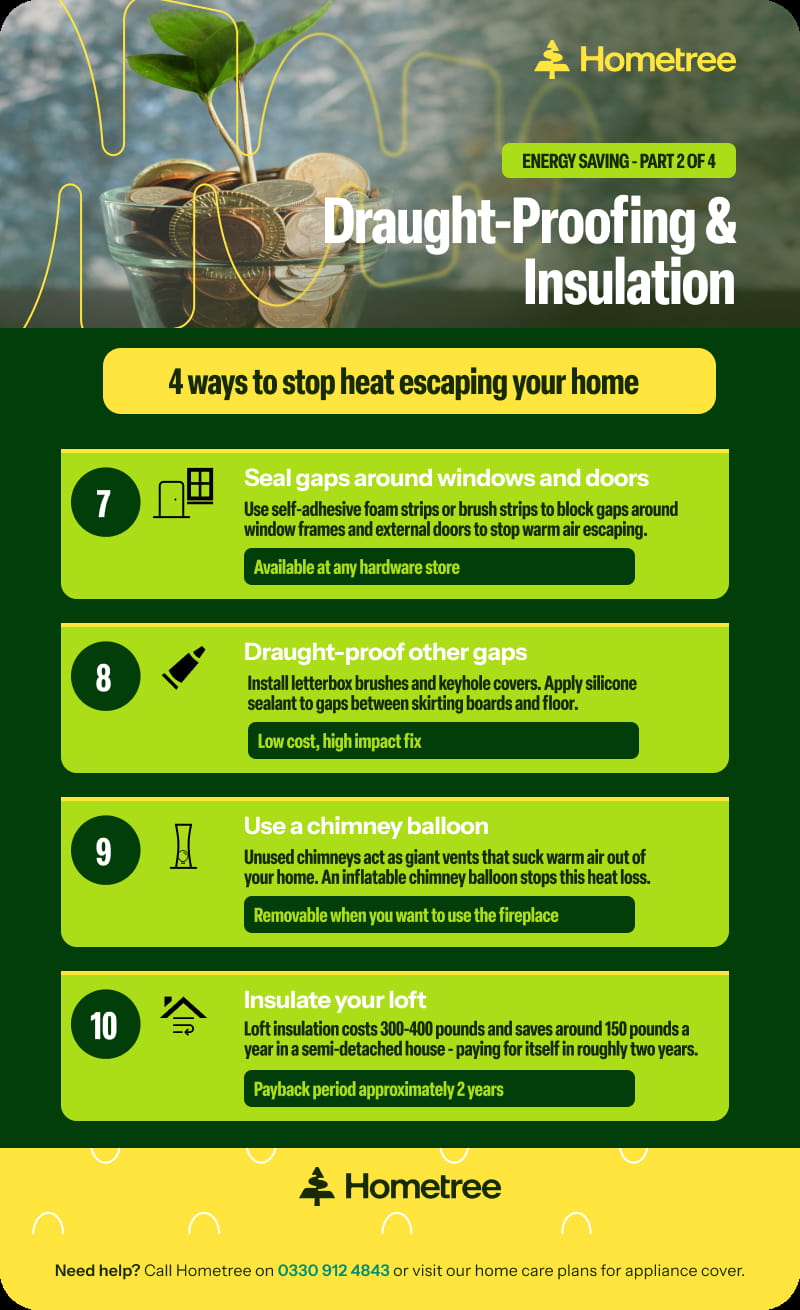
Use self-adhesive foam strips or brush strips to block gaps around window frames and external doors to stop warm air escaping.
8. Draught-proof letterboxes, keyholes, and skirting boards
Install letterbox brushes and keyhole covers to block cold air.
And apply silicone sealant to any gaps between your skirting boards and the floor to stop cold air rising from your foundations.
9. Block unused chimneys with a chimney balloon
Unused chimneys act as giant vents that suck warm air out of your home.
Placing an inflatable chimney balloon inside the flue stops this heat loss and blocks cold draughts from entering.
10. Insulate your loft
Loft insulation is a highly cost-effective upgrade. Installing loft insulation typically costs £300 to £400 and saves £150 a year in a semi-detached house.
So, the work could pay for itself in roughly two years.
11. Insulate your cavity or solid walls
Wall insulation prevents massive amounts of heat from escaping through the fabric of your home.
While solid wall insulation costs more upfront, you can make big long-term savings on your heating bills.
Hot water efficiency
12. Fit a polyurethane jacket to your hot water cylinder
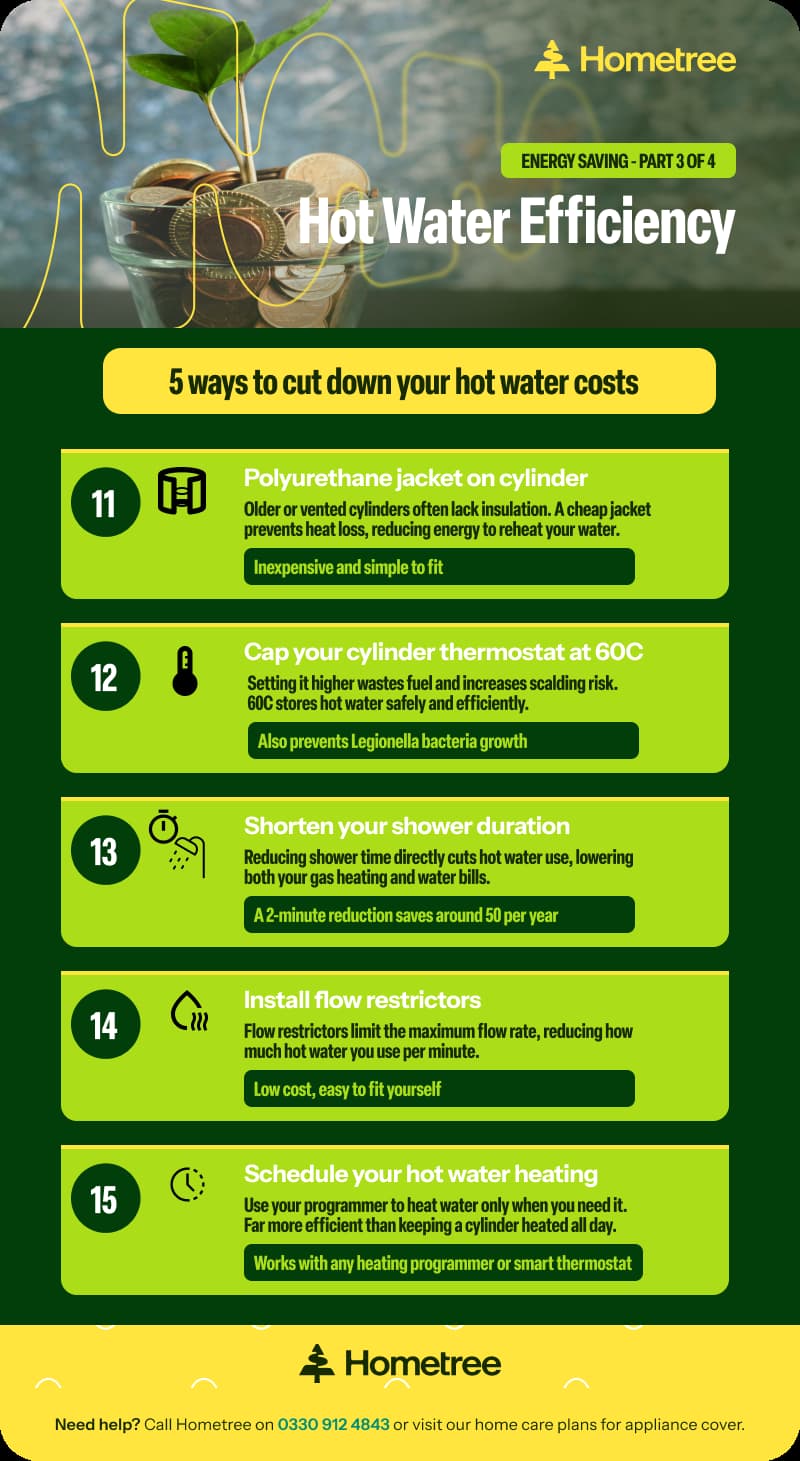
Older or vented hot water cylinders often lack built-in insulation. Fitting a cheap polyurethane jacket prevents heat loss, meaning your boiler uses less energy to reheat your water.
13. Cap your cylinder thermostat at 60°C
Setting your hot water cylinder thermostat higher than 60°C wastes fuel and increases the risk of scalding. Keeping it capped at 60°C stores water safely and efficiently.
14. Shorten your shower duration
Reducing the time you spend in the shower directly cuts the amount of hot water you use. This minimises both your gas heating bills and your water usage.
15. Install flow restrictors on taps and showerheads
Flow restrictors limit the maximum flow rate, reducing how much hot water you use per minute.
16. Schedule your hot water heating
Use your heating programmer to schedule your hot water to heat up only when you need it. This is far more efficient than keeping a hot water cylinder heated all day long.
Electricity, lighting, and appliances
17. Switch to LED light bulbs
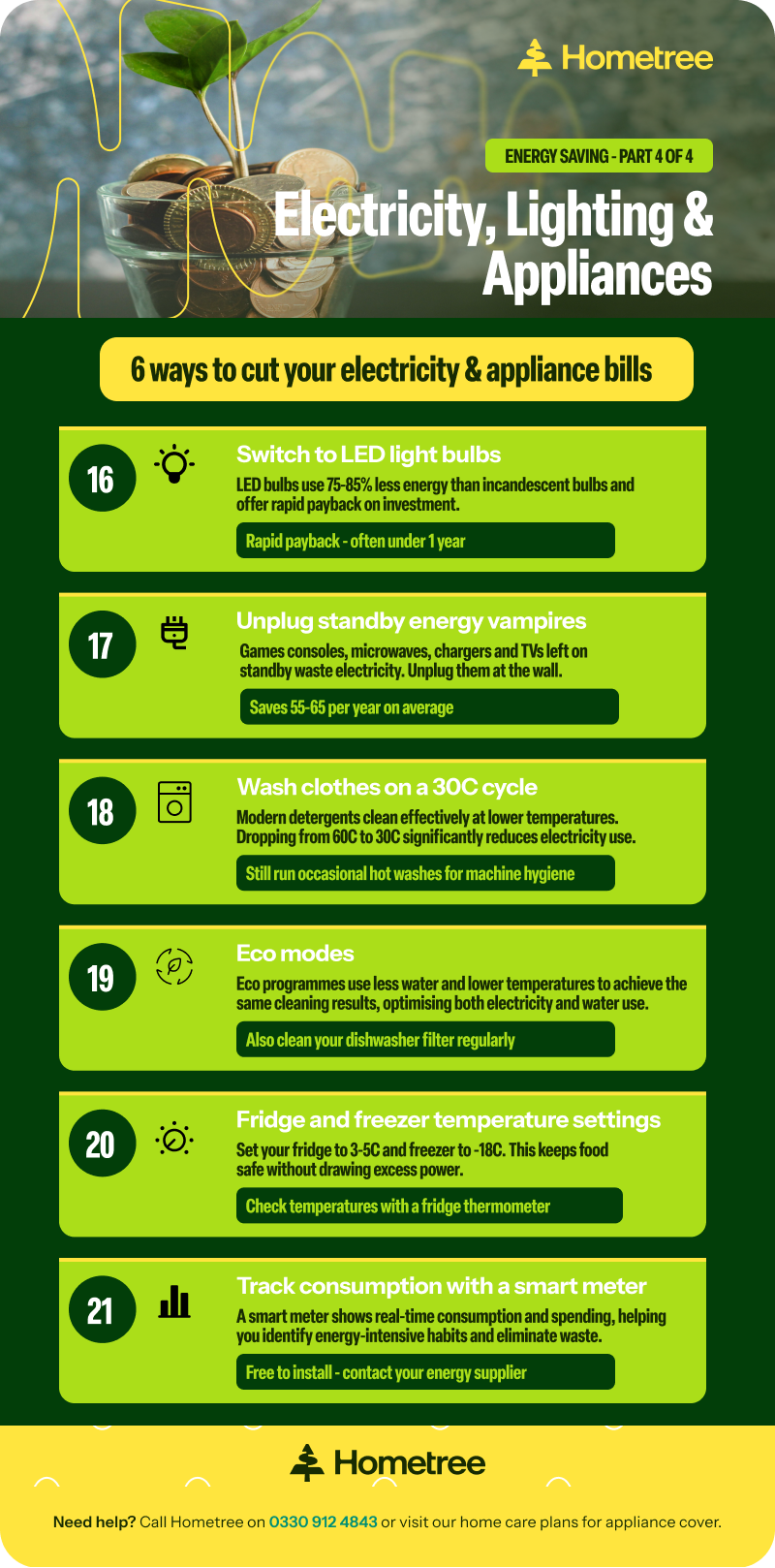
Lighting is a major source of energy use. LED light bulbs use 75% to 85% less energy than traditional incandescent bulbs.
Switching your home’s bulbs to LEDs offers a rapid payback on your investment.
18. Unplug standby energy vampires
Leaving non-essential appliances on standby wastes electricity.
Unplugging devices at the wall can save the average household £55 to £65 a year. High-draw appliances include:
- Games consoles
- Microwaves
- Phone and laptop chargers
- Televisions.
There are also more energy-efficient appliances within categories to consider, too.
19. Wash clothes on a 30°C cycle
Modern washing machines and laundry detergents are designed to clean highly effectively at lower temperatures.
Dropping your cycle from 60°C to 30°C significantly reduces the electricity needed to heat the water .
However, do note: You should still occasionally run higher temperature washes as part of your washing machine maintenance.
20. Use dishwasher and washing machine eco modes
Eco programmes use less water and heat dishwashers to lower temperatures, but run for longer to achieve the same cleaning results.
This optimizes both electricity and water use.
Regularly cleaning your dishwasher also helps maintain its efficiency and longevity.
21. Set your fridge and freezer temperatures correctly
Set your fridge between 3°C and 5°C, and your freezer at -18°C. This keeps your food fresh and safe without drawing excess power.
22. Track consumption with a smart meter
A smart meter does not save energy on its own, but it shows your real-time consumption and spending.
This transparency allows you to identify energy-intensive habits and eliminate waste.
Long-term energy investments
23. Upgrade to a modern condensing boiler
If your boiler is old, upgrading to a modern condensing boiler will reduce your carbon footprint and bills.
Condensing boilers capture waste heat from cooling flue gases, raising their overall efficiency up to 90%.
24. Install an energy-efficient heat pump
Air-source and ground-source heat pumps extract heat from the air or ground using a small amount of electricity. They offer high sustainability and function at a typical efficiency of 300% to 400%.
25. Install solar panels and battery storage
Solar panels allow you to generate your own electricity, decreasing your reliance on the grid.
And pairing solar panels with battery storage allows you to store excess power to use when the sun is not shining.
Get your home appliances covered with Hometree
Our home appliance cover includes unlimited repairs, an annual boiler service, zero parts & labour charges, and 24/7 claims support to keep your home warm. Subject to exclusions and T&Cs apply.
With no hidden fees and coverage across England, Scotland, and Wales, we’ve got you covered.
You can get covered today or contact us for a free quote.


We Beat or Match Any Quote
Phone us to beat or match British Gas or Homeserve quotes, Terms apply.

Serious About Service
24/7 claims support & rated Excellent on Trustpilot

Cover Match Guarantee
£50 gift card if we don’t cover something British Gas or Homeserve do, terms apply

All Gas Boilers Covered
All makes and models, regardless of age