Power, Electric or Mixer Shower: What Suits Your Home?

For many of us, the shower is not just a place to wash.
It is a unique creative sanctuary where we might unwind (sometimes by singing) or experience brilliant thoughts.
So choosing the right shower for your home matters. You need to consider:
- Water pressure
- Bathroom size
- Boiler types
- Energy bills.
And more.
Choosing between power showers and electric showers is a key part of this.
How do showers work?
At the simplest level, a shower combines cold water and hot water at a mixing valve. The valve blends these supplies together and sends the water to the shower head at your chosen temperature.
Where that hot water comes from depends on your home’s heating system.
In homes with conventional plumbing, hot water is supplied from a hot water cylinder. This water is heated in advance by a system or conventional boiler.
If you have a combination boiler, however, there is no hot water cylinder. A combi boiler heats water on demand as it flows to your taps or shower.
Notes on showers
Cleanliness is not a modern invention
We often imagine people in the Middle Ages and Tudor England as dirty and unwashed.
However, whilst they did not have modern high-pressure systems, they took personal hygiene and daily grooming very seriously.
They kept fresh by using localised sponge baths, botanical infusions, and herbal washing waters.
Ditching the soap entirely
In a fascinating scientific experiment, doctor and journalist Dr James Hamblin stopped taking regular showers altogether to study the biology of skin health.
Surprisingly, he did not stink. His experiment challenged modern social norms and highlighted how washing less can help protect the natural microbiome of our skin
Types of showers
Power shower
A power shower mixes hot and cold water from your home’s supplies to reach your chosen temperature. It’s designed for low-pressure, gravity-fed water systems that have a hot water storage cylinder.
To boost the water flow, a power shower has an internal electric pump (housed in a small box on the shower wall). The pump increases the water pressure to deliver a much stronger (and more satisfying) jet spray.
Electric shower
An electric shower is an independent unit that only needs a cold water supply. It uses an internal electric heating element to heat the cold water instantly as you use it.
It doesn’t rely on your boiler for hot water, so you can still enjoy a hot shower if your boiler breaks down.
Electric showers are also a great solution if your plumbing can’t easily reach a new bathroom. This is a common issue with loft conversions, for example.
Mixer shower
A mixer shower draws water from both your hot and cold water supplies, blending them in a valve before it reaches the shower head.
Unlike a power shower, a standard mixer shower does not contain an internal pump. It relies entirely on your existing mains or boiler water pressure to deliver the flow.
If you have high water pressure, a mixer shower can deliver a highly satisfying flow rate without needing electricity.
Thermostatic shower
A thermostatic shower is a mixer shower equipped with a built-in thermostatic valve. This valve monitors and regulates water temperature in real-time.
If someone flushes a toilet or turns on a tap elsewhere in the house, the valve instantly adjusts the hot and cold water flow. This maintains a stable temperature, preventing sudden cold or hot spikes.
Combi boilers’ importance for showers
Boiler compatibility is the most important factor when choosing a shower.
You can’t use a power shower with a combi boiler, for example. A combi boiler does not have a hot water storage cylinder. It heats water on demand and delivers it at mains pressure.
Power showers are designed to pump water from a low-pressure cylinder, so they aren’t compatible with combi boilers. Connecting a pump to mains water is also illegal in the UK (it can damage the water mains).
If you have a combi boiler, a standard mixer shower will already deliver excellent pressure.
Electric showers and combi boilers
You can use an electric shower with a combi boiler. But it is rarely the most efficient option.
Combi boilers are highly efficient at heating water using gas. And gas is generally much cheaper than the electricity used by an electric shower.
So, it’s usually more cost-effective to let your combi boiler heat the water for a standard mixer shower.
However, installing an electric shower in a second bathroom can be a smart move if you want to avoid pressure drops when multiple showers are used at once.
Water and energy bills: how can I make a saving?
Your running costs depend on your boiler type, household habits, and energy tariff.
Under the Ofgem price cap (as of August 2026), the average standard electricity rate is around 22.4p per kWh.
This means a 10-minute shower using a 7.5kW electric shower (which consumes 1.25 kWh of electricity) would cost approximately 28p.
By comparison, a power shower does not use electricity to heat water. It relies on your boiler to heat the water and a small electrical pump to boost the pressure.
However, power showers can use up to 15 litres of water per minute. A 10-minute shower will wash away 150 litres of water.
This is significantly more water than an electric shower uses. And heating that large volume of water requires a lot of energy from your boiler, which can lead to higher overall utility bills.
To save money and water, you can install an eco-friendly shower head. This reduces the flow rate without sacrificing water pressure.
Is a power, electric, or mixer shower best for you?
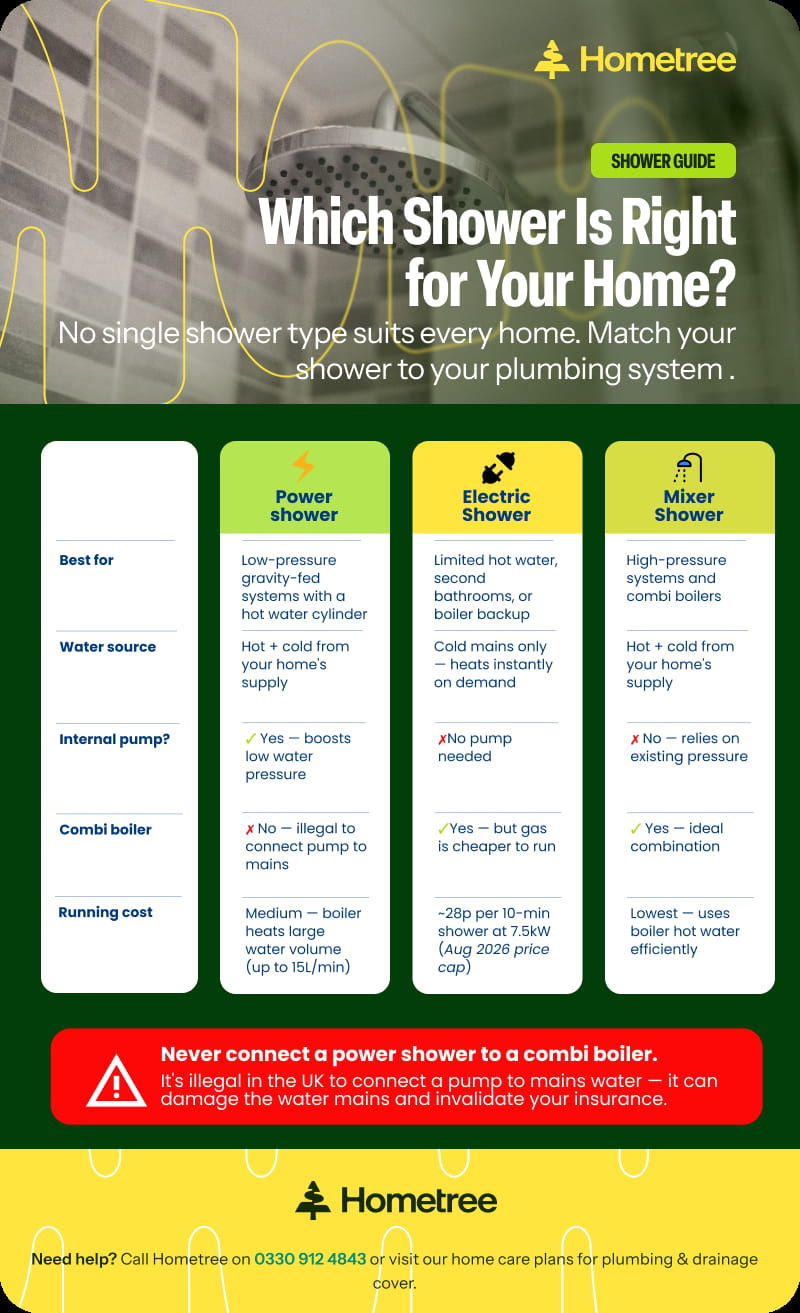
No single shower type is best for every home. Your decision should depend on your plumbing system and water pressure:
- Power showers are ideal if you have a low-pressure, gravity-fed system with a hot water cylinder and want to boost water flow.
- Electric showers are best if you have a limited hot water supply, want a backup option in case your boiler fails, or are adding a second bathroom.
- Mixer showers are the perfect match for high-pressure systems, including homes with combi boilers or unvented hot water cylinders.
Power shower vs mixer shower
A power shower is essentially a mixer shower with a built-in pump.
If you have low water pressure and a gravity-fed hot water cylinder, choose a power shower. If you have high water pressure or a combi boiler, choose a standard mixer shower.
Electric shower vs mixer shower
Electric showers heat cold water instantly using electricity. Mixer showers combine pre-heated water from your boiler with cold water.
Mixer showers generally offer a higher water flow rate and a more luxurious feel. But electric showers are more efficient because they only heat the exact amount of water you use.
Thermostatic shower vs electric shower
A thermostatic mixer shower uses your boiler’s hot water and protects you from sudden temperature drops by regulating the flow.
Electric showers can also include thermostatic technology. If you have a combi boiler, a thermostatic mixer shower is usually cheaper to run because it uses gas. If your boiler is small or prone to breaking down, an electric shower provides a reliable backup.
Get your boiler covered with Hometree
Our boiler insurance includes unlimited repairs, an annual boiler service, zero parts & labour charges, and 24/7 claims support to keep your home warm. Subject to exclusions and T&Cs apply.
With no hidden fees and coverage across England, Scotland, and Wales, we’ve got you covered.
You can get covered today or contact us for a free quote.


Get a free home cover quote

We Beat or Match Any Quote
Phone us to beat or match British Gas or Homeserve quotes, Terms apply.

Serious About Service
24/7 claims support & rated Excellent on Trustpilot

Cover Match Guarantee
£50 gift card if we don’t cover something British Gas or Homeserve do, terms apply

All Gas Boilers Covered
All makes and models, regardless of age