Types of Door Locks: A Complete Guide

Understanding different door lock types helps you make informed choices.
This guide explains the primary types of house locks used across UK homes, highlights where each lock type works best, and details the security standards insurers expect.
Further reading
Matching lock type to door type
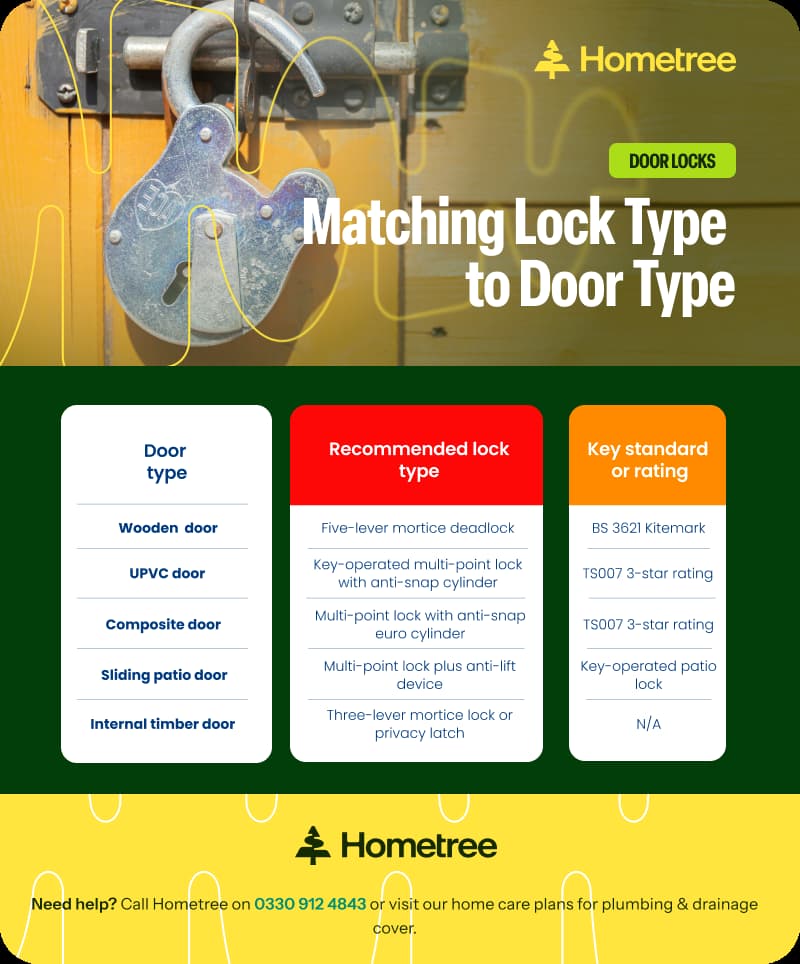
Different types of door lock suit specific door materials and construction styles.
Fitting the wrong mechanism can weaken your door or invalidate your property insurance.
Five-lever mortice locks
Mortice locks use a locking mechanism set directly into a space cut into the door edge.
One common type is the mortice deadlock. It operates by using a key from either side. Turning the key extends a solid bolt from the lock into the door frame.
The phrase “five-lever” refers to the five internal levers that must align when you turn a key.
Higher numbers of levers provide more resistance to lock picking, and lower ones provide less. Insurers generally reject three-lever mortices on external doors.
BS 3621
When buying a mortice deadlock for an external wooden door, ensure it conforms to BS 3621.
This is a British Standard that certifies a lock has passed rigorous independent tests against picking, drilling, and forced entry.
Compliant locks have an engraved British Standard Kitemark symbol on the faceplate.
Timber construction
Mortice deadlocks are usually installed in timber doors (they are not suitable for UPVC door handles or composite frames).
This provides a generally sturdy lock for day-to-day life.
When fitting a mortice deadlock in a timber door, ensure the door itself is solid hardwood or solid core.
A mortice lock in a hollow-core door offers significantly less resistance to forced entry attempts.
Cylinder locks and anti-snap cylinders
Cylinder locks operate using a euro cylinder, which is a barrel into which a key is inserted.
In the UK, they are the most common front door lock types on modern UPVC and composite doors.
Standard euro cylinder vulnerabilities
Standard euro cylinders offer convenience and allow ‘keying alike’ (configuring multiple barrels so that one key opens several doors).
However, basic cylinder locks suffer from a major security flaw: lock snapping. Burglars can snap the external cylinder barrel to expose the lock’s internal mechanism and open the door in seconds.
Standard unrated cylinders offer little to no resistance against this technique. So, home security experts advise against using them on external doors.
Upgrading to anti-snap cylinders
An anti-snap cylinder is a high-security barrel engineered with a sacrificial break line.
If someone attempts to force the lock, the outer portion snaps off and the internal mechanism stays intact. This leaves the door securely locked.
If you’re looking for an anti-snap replacement, look for hardware certified to TS007 3-star. This is UK standard for enhanced cylinder security tested against:
- Snapping
- Picking: Manipulating locks’ internal pins with a specialist tool that aligns them, opening the lock without force or damage
- Bumping: Using a specially cut bump key struck with light force to jolt the pins into the unlocked position.
- Drilling: Destroying the lock’s pin mechanism by drilling directly through the cylinder. This bypasses the need to pick or break it.
Fitting a TS007 3-star cylinder onto a UPVC or composite door dramatically improves resistance to forced entry, and many insurers now require this upgrade on modern doors.
Key-operated multi-point locks
A multi-point locking system bolts a door into its frame at three or more points simultaneously with one key turn. Most UPVC and composite doors installed over the last 15 years have this.
Multi-point mechanisms and euro cylinders work together:
- Multi-point systems provide deadbolts, hook bolts, and rollers along the door frame
- Euro cylinders act as the central control barrel where you insert the key.
To secure a multi-point lock fully, you lift the handle upward to engage all locking points before turning the key.
Combining a multi-point mechanism with an anti-snap euro cylinder creates a highly effective (residential) security setup.
Locks for sliding patio doors
Sliding patio doors offer excellent natural light but present unique security challenges. For example, older designs can be lifted off their tracks and removed entirely.
To secure them, install a multi-point locking system along the meeting edge of the door (where the sliding and fixed panels meet). This will lock into place (with a key) at several points simultaneously.
Alternatively, you can fit locks at both the top and bottom of the sliding panel. Always pair your lock setup with an anti-lift device. This is a metal stop fitted above the door track.
For advice on securing secondary glazing and window openings, read our guide on types of window locks.
Night latches and secondary security
A night latch is a surface-mounted lock that catches automatically when the door closes. It’s convenient for everyday latching on wooden doors.
However, you should never rely on a night latch as the sole lock on an external door.
Night latches come in two primary variations:
- Standard night latches: These latch automatically upon closing but unlock from the inside via a simple lever.
- Deadlocking night latches: These allow you to lock the internal handle with a key. They prevent intruders from opening doors by exploiting letterboxes or broken glass.
Insurance requirements for house locks
Home insurance providers set minimum security requirements for external doors before issuing coverage.
In other words, if an unapproved lock fails during a break-in, your provider might reject your claim.
Most UK insurers mandate the following standards for ground-floor or accessible exterior doors:
- Timber doors: Five-lever mortice deadlock conforming to BS 3621.
- UPVC or composite doors: Key-operated multi-point lock with at least three locking points, ideally paired with a TS007 3-star anti-snap cylinder.
- Sliding patio doors: Multi-point lock or key-operated patio locks fitted top and bottom with anti-lift protection.
If your locks suffer damage or fail to operate correctly, check whether your policy includes emergency assistance.
Hometree’s Your Home Plus plan covers emergency locksmith access and lock replacement on external doors and windows.
To learn more about standard policy inclusions and optional add-ons, read our guide on why you need locks and keys insurance.
Getting locks fitted by a vetted locksmith
Always hire a vetted professional to fit or replace any house door lock. Use the official directory of the Master Locksmiths Association (MLA) at locksmiths.co.uk to find one in your area.
MLA-registered locksmiths undergo background checks, regular inspection, and practical examination.
Further reading
Lock buying guide checklist
Use this essential checklist when purchasing new locks or auditing your home security:
- Check the door material: Select a five-lever mortice deadlock for timber doors, or a multi-point lock with an anti-snap cylinder for UPVC and composite doors.
- Verify certification marks: Look for the British Standard BS 3621 Kitemark on mortice locks, or a TS007 3-star rating on euro cylinders.
- Check anti-snap protection: Ensure cylinder locks feature anti-snap, anti-pick, anti-drill, and anti-bump engineering.
- Review insurance terms: Confirm that your chosen hardware meets your insurer’s minimum security requirements for external entry points.
- Learn correct operation: Ensure family members know how to lift handles to double-lock multi-point systems properly.
- Use accredited installers: Verify that an MLA-registered locksmith installs and tests your new locks.
Get home emergency cover with Hometree
Our home emergency cover includes unlimited repairs, an annual boiler service, zero parts & labour charges, and 24/7 claims support to keep your home warm. Subject to exclusions and T&Cs apply.
You can get covered today or contact us for a free quote.


We Beat or Match Any Quote
Phone us to beat or match British Gas or Homeserve quotes, Terms apply.

Serious About Service
24/7 claims support & rated Excellent on Trustpilot

Cover Match Guarantee
£50 gift card if we don’t cover something British Gas or Homeserve do, terms apply

All Gas Boilers Covered
All makes and models, regardless of age