What To Do If Your Boiler Won’t Ignite

Are you struggling to get your boiler pilot light to ignite?
If so, your heating and hot water will soon go (if they haven’t already!).
Read on to learn about some simple potential causes and more.
Please note: The following article is aimed at helping you understand potential issues with your boiler. It’s always advisable to leave diagnosis and repair work to a professional boiler engineer.
Things you can check yourself
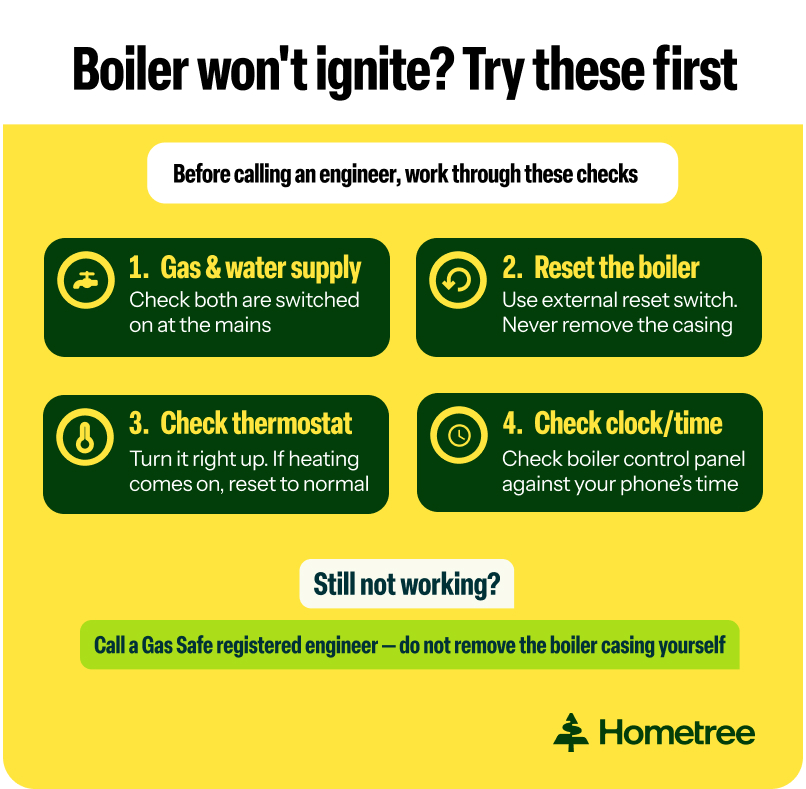
1. Check gas and water supply
Perhaps your boiler pilot light is working, but you’re still not getting any hot water.
If so, it’s worth checking the gas supply and water supply are both switched on.
Accidents happen, and sometimes they get switched off. Turning them back on could save you the cost and inconvenience of calling out an engineer.
2. Reset your boiler
It’s also worth trying to reset your boiler. Of course, this is if there is a switch on the outside you can access.
Follow your manufacturer’s instructions for guidance. Never remove the casing – this is Gas Safe registered engineers’ territory only!
Interfering with the internals of your boiler could potentially put you and those living in your property at risk.
3. Check thermostat settings
It may be worth checking your thermostat settings. Maybe there was a power cut or your device has been knocked.
Turn the thermostat right up to see if you get any hot water. If it works, go back and reset your thermostat to its normal setting.
4. Check clock/timer
If the clocks have recently gone back or forward, your clock or timer could be wrong.
Check on your phone that the time you’re seeing there is the same as the one on your boiler’s display.
5. Check for draughts
A draught could be blowing out the pilot light on your boiler.
Check by holding the back of your hand near potentially poorly sealed windows or under doors.
If you find one, draught-proof the area around your boiler with a cover.
Faults that need an engineer
1. Pilot light issues
Pilot lights are an issue for older boilers, newer types of boilers don’t have them (see below).
Your heating or hot water might be out if there’s no pilot light on or it keeps going out.
Pilot lights ignite the gas burner, which heats the water that flows through your central heating system.
If the pilot light has gone out, you might be able to reset it following your manufacturer’s instructions.
Older boiler pilot lights may require a lit match for ignition – which we don’t recommend (there could be other issues with leaking gas).
It might not be possible for them to be lit because debris is blocking the jet.
Boiler pilot light jets can also be removed, cleaned and re-installed.
What colour is your pilot light?
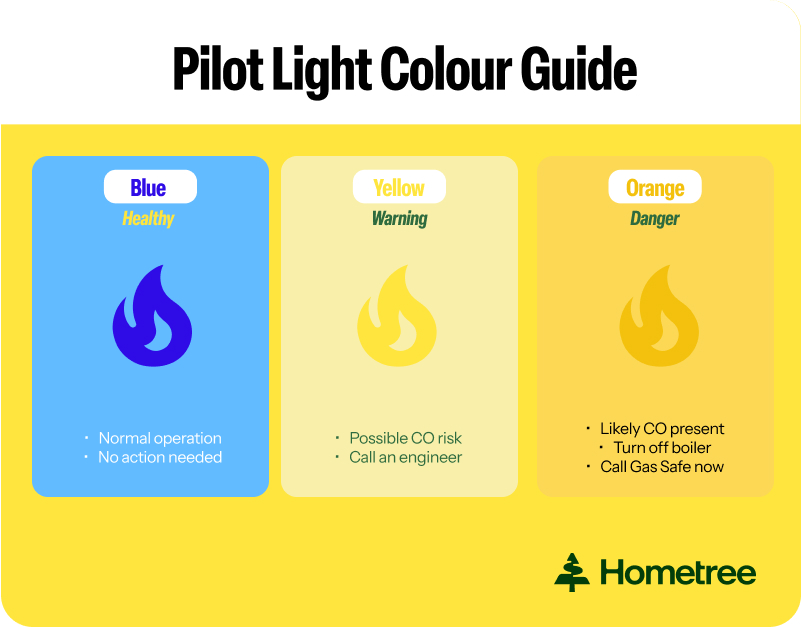
If your boiler is igniting, but you notice an orange pilot light or yellow gas pilot light, it could be producing carbon monoxide.
This is an odourless, poisonous gas that can be fatal.
Getting a CO detector fitted and maintaining it is a safety essential.
Your pilot light’s colour can be an important clue to how it’s working. It should be crisp and blue.
If it’s any other colour, turn off your boiler and contact a registered Gas Safe engineer immediately.
Newer boilers don’t have pilot lights
Newer boilers have an ignitor (also known as an electrode) in place of a pilot light.
This uses heat-resistent metal rods inside insulated ceramic containers. If it isn’t working, the boiler should cut out to prevent gas build up.
Engineers adjusting the pilot light valve
If the flame on your pilot light is on but weak, your engineer may try and adjust it.
They will likely refer to its manufacturer instructions to locate the screw on the pilot light valve. This can be used to adjust the flame.
They will then turn the screw until the flame is blue and crisp.
Blocked boiler flue
A blocked or damaged boiler flue can also prevent your boiler from firing up.
Most modern boilers will automatically shut down if combustion gases can’t safely escape.
This is another fault that requires a Gas Safe registered engineer to inspect and resolve.
Problem with the gas valve
Gas valves control the flow of gas to your boiler. If more heat is needed, the valve opens up to provide more fuel. The same goes for hot water.
If the gas valve is blocked, seizes up or the connections are damaged, it can’t do its job correctly. This could be the reason your boiler won’t ignite.
In most cases, your boiler will shut down to prevent the danger of it from being supplied with too much or too little gas.
A faulty gas valve requires the expertise of a Gas Safe registered engineer to identify and repair.
Faulty thermocouple
If your pilot light and your boiler won’t turn on, there could be a problem with the thermocouple.
A thermocouple is a sensor that keeps the gas valve open by generating a small electrical current when heated by the pilot light’s flame. If the flame goes out, the current stops, which closes the valve.
It’s essentially a safety device to ensure gas does not leak out from your boiler when the pilot light isn’t on.
If this is the problem, you should have it inspected – and potentially replaced – by a Gas Safe registered heating engineer.
Blocked burner
If carbon gets clogged up in your boiler’s burner, your appliance may run inconsistently or stop working altogether.
Hiring a heating engineer to clear out the carbon should fix the issue.
Although, if your burner is at the end of its life, you will need to consider a replacement.
Burner replacements aren’t cheap. However, they might be covered by your boiler warranty or insurance.
If not, you may want to consider a new boiler installation instead.
Get your boiler covered with Hometree
Our boiler cover includes unlimited repairs, an annual boiler service, zero parts & labour charges, and 24/7 claims support to keep your home warm. Subject to exclusions and T&Cs apply.
With no hidden fees and coverage across England, Scotland, and Wales, we’ve got you covered.
You can get covered today or contact us for a free quote.


Get a fixed price boiler repair for £90

We Beat or Match Any Quote
Phone us to beat or match British Gas or Homeserve quotes, Terms apply.

Serious About Service
24/7 claims support & rated Excellent on Trustpilot

Cover Match Guarantee
£50 gift card if we don’t cover something British Gas or Homeserve do, terms apply

All Gas Boilers Covered
All makes and models, regardless of age