What Is an Immersion Heater? How It Works, Cost & Efficiency

There are several different heating technologies for homes (including different types of boiler).
Immersion heaters are one of them. They’re popular as both a back-up and primary heating source.
This guide explains how they work, what they look like, what they cost to run, and more.
What is an immersion heater?
An immersion heater is an electric water heater fitted directly inside a hot water cylinder. It heats water independently of your central heating boiler.
It’s connected by a dedicated cable to your household electricity supply. It uses this electric source to create resistance to heat water inside the tank separately from your boiler.
“Immersion” refers to the fact that this electrical element is submerged directly inside the water it’s heating.
How immersion heaters work
Instead of heating water externally, like most boilers, through pipes or flame exchangers, an immersion heater works like a giant kettle probe internal to a water tank.
When you switch it on, electric current flows through the resistance element, generating heat that warms the surrounding water. This is stored for many hours after the heater switches off.
Usage and popularity
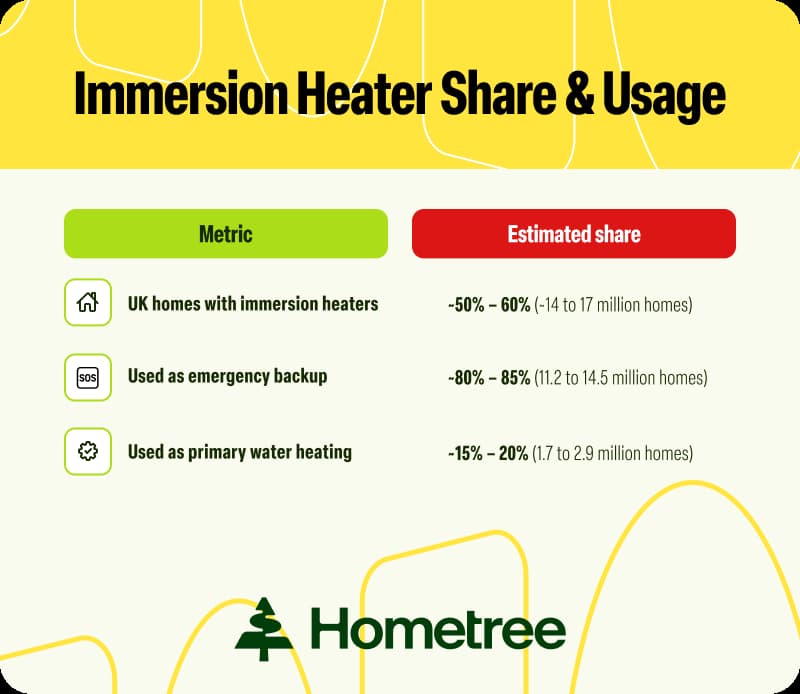
Immersion heaters turn up in a handful of common household setups.
They’re the default for all-electric properties that have no mains gas connection. And they’re standard in homes with a hot water cylinder. (In the latter cases they are typically fed by a system or regular boiler).
Increasingly, they’re also found in solar-equipped homes, where a solar diverter routes surplus generation into the immersion element to produce hot water.
Datasets such as the English Housing Survey and BRE Group energy studies estimated 50–60% of UK homes (roughly 14 – 17 million of around 28 million households) have immersion heaters inside their hot water cylinder.
That share has fallen over recent decades, largely because of the growth in popularity of combi boilers, which heat water on demand without a storage cylinder.
Most immersion heaters in the UK, however, aren’t doing the main job of heating water day to day.
In fact, around 80–85% function as secondary or backup systems. The remaining 15–20% provide the household’s primary hot water source.
What does an immersion heater look like?
If your home has a hot water cylinder, you likely have both a boiler and an immersion heater.
(The immersion heater acts as an emergency backup. If your boiler breaks down, you can switch it on the immersion heater until your boiler has been repaired.)
Immersion heaters are recognisable by their metallic heating element, shaped like a long metal rod or U-bend. It’s usually made from copper or incoloy steel.
This fits directly into a threaded socket at the top or side of your hot water cylinder, so that it can protrude into the stored water.
On the outside of the tank, a plastic cover cap protects the electrical wiring connections and houses a small thermostat control dial.
Types of immersion heater
Immersion heaters vary based on where they fit into your cylinder and how many elements they use:
- Top-entry immersion heaters: Fitted through the top of the cylinder, using a long element that reaches down to heat the entire water volume.
- Bottom-entry immersion heaters: Screwed into the side near the base of the cylinder, heating water from the bottom up.
- Dual-element immersion heaters: Feature two separate heating elements inside one cylinder. The shorter top element heats a small volume of water quickly for sinks or showers, whilst the longer bottom element heats the whole tank for baths.
Your system will also depend on your cylinder design. Direct cylinders rely entirely on immersion heaters for hot water.
Indirect cylinders use a central heating boiler as their primary heat source, with an immersion heater installed as a backup.
Immersion heater running costs
Heating water with electricity is generally more expensive than using mains gas. However, understanding running costs helps you manage your household energy budget.
A standard residential immersion heater uses 3 kilowatts (kW) of electricity per hour. At current UK energy rates (around 24p per kWh in 2026), running a 3kW immersion heater costs approximately 72p per hour.
Heating a full 150-litre tank from cold takes 2 to 3 hours, which costs between 72p and £1.44 per cycle.
If used once a day, this amounts to roughly £22 to £43 per month.
If you use an off-peak electricity tariff like Economy 7, setting a timer to heat water overnight can cut these running costs by up to 50%.
Heating water timeframes
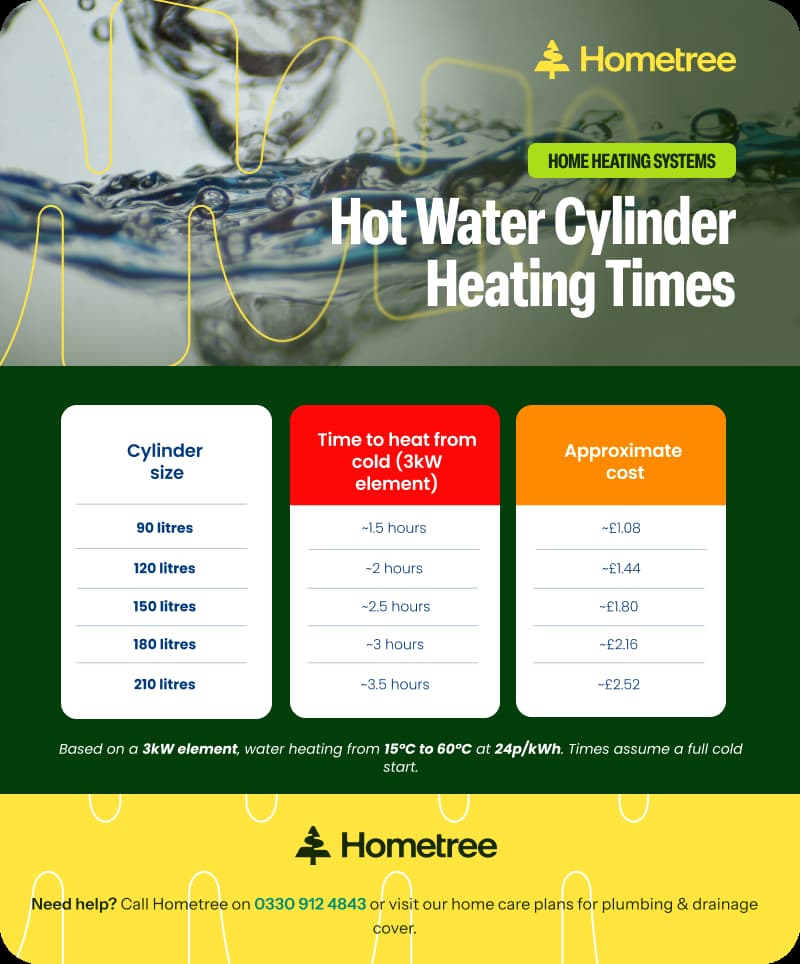
A standard 150-litre hot water cylinder takes between 2 and 3 hours to heat fully from cold using a 3kW element.
If you have a dual-element heater, switching on just the top element will heat enough water for a shower in roughly 30 to 45 minutes.
Should you leave an immersion heater on all the time?
No, you should never leave an immersion heater turned on constantly.
Even though a thermostat stops the element once the water’s hot (see below), leaving it switched on means the cylinder keeps reheating itself throughout the day as it naturally loses heat.
Modern hot water cylinders are well-insulated and hold their temperature for hours.
You should use a mechanical or digital timer to switch the heater on 30 to 60 minutes before you need hot water. This ensures you have plenty of hot water without wasting electricity.
Do immersion heaters switch off automatically?
Yes, immersion heaters usually feature a built-in thermostat that turns the element off automatically once the water reaches your target temperature.
Thermostats are usually set to 60°C to 65°C. This temperature is hot enough to kill harmful bacteria like Legionella whilst preventing scalding and saving energy.
If your water stays cold or becomes scalding hot, the internal thermostat may have failed and will need replacing.
Immersion heaters lifespans
Immersion heater elements typically last between 10 and 20 years. However, the built-in thermostat often fails sooner (due to continuous heat exposure and hard water scale).
If the entire element needs replacing, a new part costs between £15 and £40, plus a plumber’s installation cost of £100 to £200.
Immersion heater vs boiler: which is cheaper?
Mains gas is significantly cheaper per unit of energy than electricity in the UK. Heating water with a gas boiler costs roughly three to four times less than using an electric immersion heater.
However, an immersion heater remains a valuable addition to your home. It provides essential backup security during boiler breakdowns and can deliver free hot water when paired with solar panels.
Get your boiler covered with Hometree
Our boiler insurance includes unlimited repairs, an annual boiler service, zero parts & labour charges, and 24/7 claims support to keep your home warm. Subject to exclusions and T&Cs apply.
With no hidden fees and coverage across England, Scotland, and Wales, we’ve got you covered.
You can get covered today or contact us for a free quote.


We Beat or Match Any Quote
Phone us to beat or match British Gas or Homeserve quotes, Terms apply.

Serious About Service
24/7 claims support & rated Excellent on Trustpilot

Cover Match Guarantee
£50 gift card if we don’t cover something British Gas or Homeserve do, terms apply

All Gas Boilers Covered
All makes and models, regardless of age