What Temperature Should My Fridge Be? Settings, Dials & UK Laws

Setting your fridge to the wrong temperature does not just cause spoiled milk and frosted lettuce.
It also creates a breeding ground for foodborne illnesses.
In the UK, there are around 2.4 million cases of foodborne illness every year. Most of these cases are entirely preventable.
So, keeping your refrigeration system at the correct temperature is essential.
The perfect fridge temperature: Chilled but not frozen
In the UK, your fridge should be set to 4°C, or between 3°C and 5°C.
This temperature zone is cold enough to slow bacterial growth right down. And it’s warm enough to prevent your fresh food from freezing.
If your fridge rises above 5°C, your food will spoil rapidly, especially:
- Meat
- Milk
- Dairy.
If the temperature drops below 0°C, you will end up with frozen eggs, ruined lettuce, and separated milk.
What number should my fridge be on?
Most household fridges use a control dial numbered 1 to 5 or 1 to 7 (instead of displaying degrees Celsius).
Dial numbers represent cooling power, not temperature. Number 1 is the warmest setting with the lowest cooling power, and the highest number (5 or 7) is the coldest setting with the maximum cooling power.
Setting 3 or 4 is the recommended baseline for most household fridges.
Adjust your dial in small steps. And wait 24 hours for the temperature to stabilise before measuring it again.
Seasonal adjustments: Summer vs winter settings
External room temperatures directly impact how hard your compressor has to work.
- In summer, hot weather forces your compressor to work much harder to keep the interior cool. You must turn your dial to a higher number to maintain a safe temperature.
- In winter, cold kitchens reduce the external strain on your appliance. You can turn your dial to a lower number to prevent food from freezing and save energy.
Read: Simple Kitchen Appliance Care Tips to Save You Money
What temperature should a freezer be?
Your freezer requires a colder environment. The ideal temperature for a domestic freezer is -18°C.
This temperature keeps food frozen solid and safe for long periods. It preserves food texture and taste. Anything warmer than -15°C risks premature spoilage.
Read: How to Defrost a Freezer
Fridge shelf zones: Where to store what
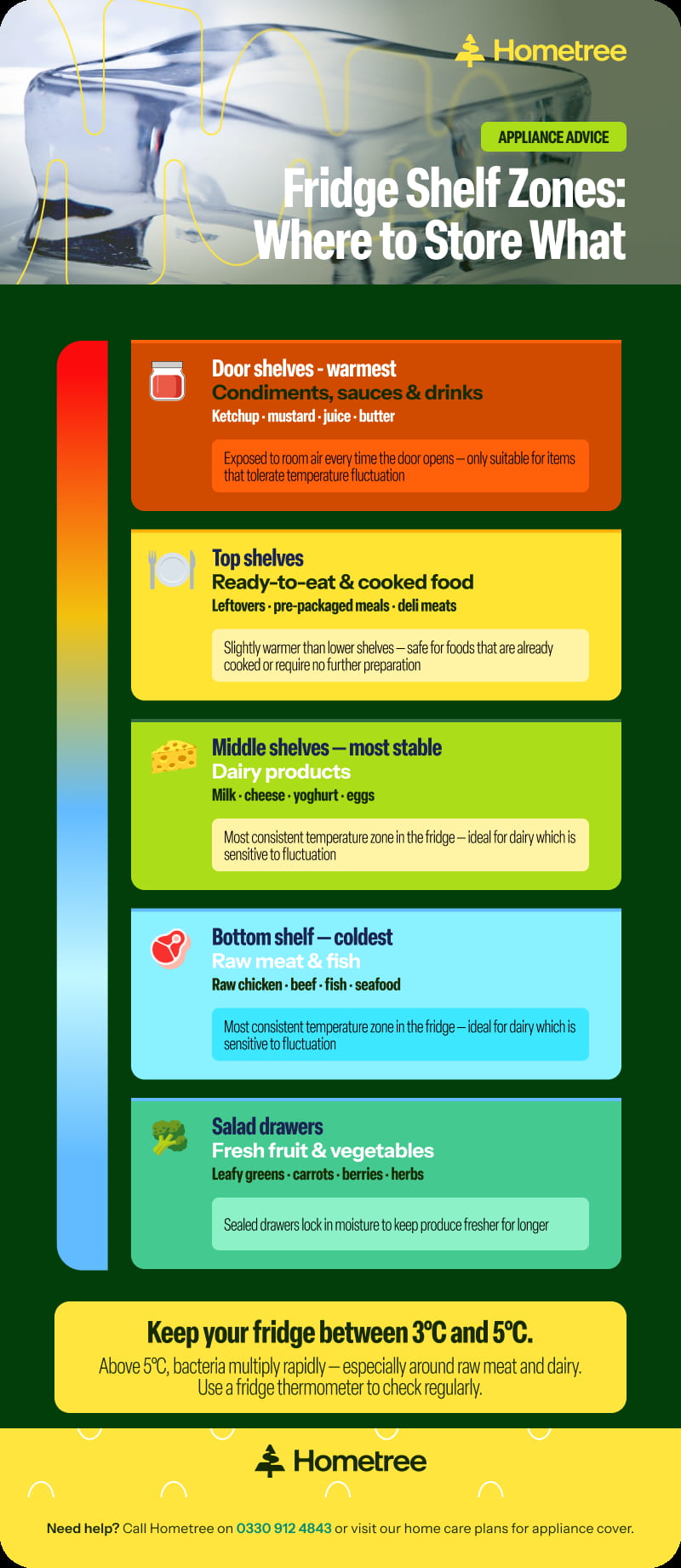
Cold air circulates unevenly inside static fridges. In contrast, fridges with ventilated or circulated air maintain a more consistent temperature. If your fridge uses static air, you must arrange your food strategically to prevent bacteria:
- The top shelves are slightly warmer. Keep ready-to-eat foods, cooked leftovers, and pre-packaged meals here.
- The middle shelves maintain a stable chill. This is the ideal spot for dairy products like milk, cheese, and yoghurt.
- The bottom shelf is the coldest part of the fridge. Always store raw meat and fish here in sealed containers to prevent hazardous drips.
- The crisper drawers lock in moisture. Keep fresh fruit and vegetables here.
- The door shelves are the warmest area because they are exposed to room air every time the door opens. Only keep condiments, sauces, and drinks here.
Modern fridge design and food waste
Modern fridge designs with massive shelves and hidden drawers encourage us to buy too much food.
It’s easy to forget what’s hidden at the back. This design flaw causes more food waste than food actually going off.
Legal requirements: UK food safety laws
Under the Food Safety (Temperature Control) Regulations, commercial food premises in the UK must legally hold chilled food at or below 8°C.
For domestic households, this legal limit is too high. A kitchen fridge should always be kept below 5°C to guarantee safety.
Allowing your fridge to hover near 8°C dramatically accelerates the growth of food poisoning pathogens.
How to check your fridge temperature without a thermometer
You do not need a digital thermostat display to spot a failing cooling system. Your fridge will display clear physical warning signs when the temperature is wrong:
Sour milk
Milk sours because bacteria that survive pasteurisation feed on lactose (milk sugar) and convert it into lactic acid. That rising acidity lowers the milk’s pH, which causes them to clump into curds, leaving behind a yellowish liquid called whey.
Warm conditions let the bacteria multiply far faster, which is why milk at room temperature can turn within hours.
A small sip of spoiled milk usually just tastes unpleasant. But ingesting more can bring on genuine food poisoning-style symptoms (nausea, vomiting, diarrhoea, etc.).
Interestingly, the bacteria responsible for the sour taste and texture aren’t usually the same ones that cause serious illness.
The latter are spoilage bacteria and harmful pathogens like E. coli or listeria, which thrive under the same warm, poorly-stored conditions. A fridge running too warm raises the odds of both at once.
Frozen or rotten produce
At the short end, leafy greens are consistently the fastest to go off. Spinach, kale, lettuce and similar greens typically only hold up for 3–7 days in the fridge.
This is because leafy vegetables need the most ongoing moisture and nutrients to stay viable, so they collapse fastest once cut from the plant.
Cabbage tells the same story in miniature. The outer layers protect the core, so a whole head can sit quietly in the fridge’s salad drawer for over a month whilst loose lettuce next to it dies within days.
Carrots’ leafy tops pull moisture out of the root and cause shrivelling. But unpeeled carrots stored can last up to a month or two. Beets follow a similar pattern and can last for two to four months (if sealed and in the salad drawer).
Onions are the outlier that doesn’t even need refrigeration. Stored somewhere cool, dry and ventilated, they’ll keep for several months.
Ice sheets
The back wall of a fridge hides the evaporator coils, the coldest part of the appliance.
In normal operation, moisture from the air condenses there and is melted away automatically every time the compressor cycles off, draining out through a small channel at the back.
Ice buildup here means that the defrost cycle has stopped working properly. This could be due to a warm-air leak from a worn door seal, or vents and airflow paths blocked by food.
You should not chip ice away with a knife or other sharp tool, as it can puncture the coils behind the panel.
The ice here should never be ingested. Listeria can grow in the fridge, and survive even in the freezer. And ice can harbour bacteria like E. coli, Salmonella and Listeria, which reactivate once ice melts or the food thaws.
Puddles
A fridge doesn’t need water to function. So any moisture you see likely comes from two main places: normal condensation from air inside the fridge meeting the cold evaporator coils or warm air from outside sneaking in.
During the fridge’s defrost cycle, melted frost should be funnelled through a small drain hole and expelled via a tube. Puddles appear when that route gets blocked.
Food debris is by far the most common culprit, responsible for around 70% of clogs. However, ice buildup and mould growth inside the drain channel can do the same thing.
Fridges with built-in ice makers or water dispensers add a third possible source: a broken supply line. So a puddle isn’t automatically a temperature problem in this case.
Funny tastes
Taste perception varies a lot between people, who can literally have different numbers of taste buds.
Around a quarter of people are ‘supertasters’, and a similar share are ‘non-tasters’. Everyone else falls in between on a sliding scale. This is basically true of smell, too.
In other words, two people tasting of sniffing the same gone off milk or meat could disagree!
However, it’s worth noting that food tasting and smelling completely normal doesn’t mean it’s safe.
Bacteria like Salmonella, Listeria and E. coli can exist in food without changing how it looks, smells, or tastes at all.
That’s why it’s best to always go by dates and storage temperature rather than your own senses!
Why is the back or top of my fridge hot?
Your fridge can also flag problems from the outside
It is normal for the back or top of your fridge to feel warm. Your fridge is a heat pump; it extracts heat from the inside and pumps it out into your kitchen.
This heat is dissipated through the condenser coils located on the back or sides of the unit.
However, excessive heat is a major warning sign. It means your compressor is running constantly and working too hard.
Common causes of an overheating fridge include:
- Dirty coils: Dust and pet hair insulating the coils and blocking heat transfer.
- Poor ventilation: Placing the fridge too close to walls or inside tight, unvented cabinets.
- Degraded door seals: Cracked seals letting warm kitchen air invade the cabinet.
An overworked compressor will eventually burn out, leading to a sudden, expensive system breakdown. This is why a robust appliance cover is an essential safety net.
Get your home appliances covered with Hometree
Our home appliance cover includes unlimited repairs, an annual boiler service, zero parts & labour charges, and 24/7 claims support to keep your home warm. Subject to exclusions and T&Cs apply.
With no hidden fees and coverage across England, Scotland, and Wales, we’ve got you covered.
You can get covered today or contact us for a free quote.


Get a free appliance cover quote

We Beat or Match Any Quote
Phone us to beat or match British Gas or Homeserve quotes, Terms apply.

Serious About Service
24/7 claims support & rated Excellent on Trustpilot

Cover Match Guarantee
£50 gift card if we don’t cover something British Gas or Homeserve do, terms apply

All Gas Boilers Covered
All makes and models, regardless of age