Washing Machine Cover: Lifespans, High-Tech Failures, & Exclusions

Washing machine problems are disruptive to our day-to-day lives.
And in the UK, millions of homes don’t have emergency savings. So, without the right kind of appliance cover, breakdowns are also financially disruptive.
Understanding washing machines’ mechanical strain, historical significance, and tech vulnerabilities helps you protect your appliance.
Why washing machines matter
Clean laundry is easy to take for granted. Yet some economists and social commentators argue that the washing machine is more consequential to modern society than the internet.
Washing clothes was a manual task for centuries. It took eight to twelve hours of physical labour every week! It often involved doing the following by hand:
- Boiling and carrying water
- Soaking
- Scrubbing and wringing
- Rinsing.
The automated washing machine fundamentally transformed domestic life by reducing this down to a fraction of the original hours.
It liberated households from physical chore, allowing for significantly more leisure time.
Front-loaders, top-loaders, and hybrids
There are three distinct drum configurations for washing machines:
- Top-loaders: These traditional designs let you drop laundry in from above. They offer an easy, functional design, but often consume a relatively high amount of water.
- Front-loaders: These energy-efficient machines use horizontal drum rotation to tumble clothes. However, they rely on door seals that degrade over time.
- Hybrids: These newer designs combine top-loading accessibility with front-loading efficiency.
Some futurists even imagine waterless laundry. But as long as machines rely on high water pressure and heat to dissolve detergent, they remain vulnerable to physical wear.
Mechanical stress and repair barriers
A washing machine drum spins at speeds exceeding 1400 RPM (revolutions per minute). And it constantly cycles hot and cold water. This creates immense physical wear, including:
- Temperature strain: Constant cycling between hot and cold washes causes expansions and contractions in seals, pipes, and internal components.
- Bearing friction: High-spin speeds put extreme pressure on metal bearings. If water breaches the seal, bearing failure occurs.
- Electronic complexity: Modern machines rely on digital control boards. Repair technicians increasingly use special diagnostic tools or programming, which can become expensive.
Does contents insurance cover washing machines?
No. Standard contents insurance does not cover washing machine breakdowns.
Contents policies protect against specific events like theft, fire, or flooding, but exclude failures caused by everyday wear and tear.
So if your drum bearing fails or your control board burns out, your contents insurer won’t pay.
Manufacturer warranties don’t fill the gap either. They typically expire after one to two years, leaving you exposed for the majority of your machine’s working life.
Washing machine insurance is designed to bridge exactly these gaps.
What appliance cover includes
A dedicated washing machine policy often covers the primary drivers of repair bills:
- Call-out fees: The cost to get a certified engineer to your home.
- Parts and labour: The technical hours and replacement components needed to fix the machine.
- Emergency replacements: If your machine is beyond economic repair, a quality provider will replace the unit.
Key exclusions
Washing machine policies have specific exclusions, such as:
- Pre-existing faults that occurred before your policy started
- Cosmetic issues like scratches, or consumables like fuses and bulbs
- Irresponsible use such as overloading the drum or using the wrong detergent
- Strict age limits on older machines where replacement parts are obsolete.
Washing machine cover costs
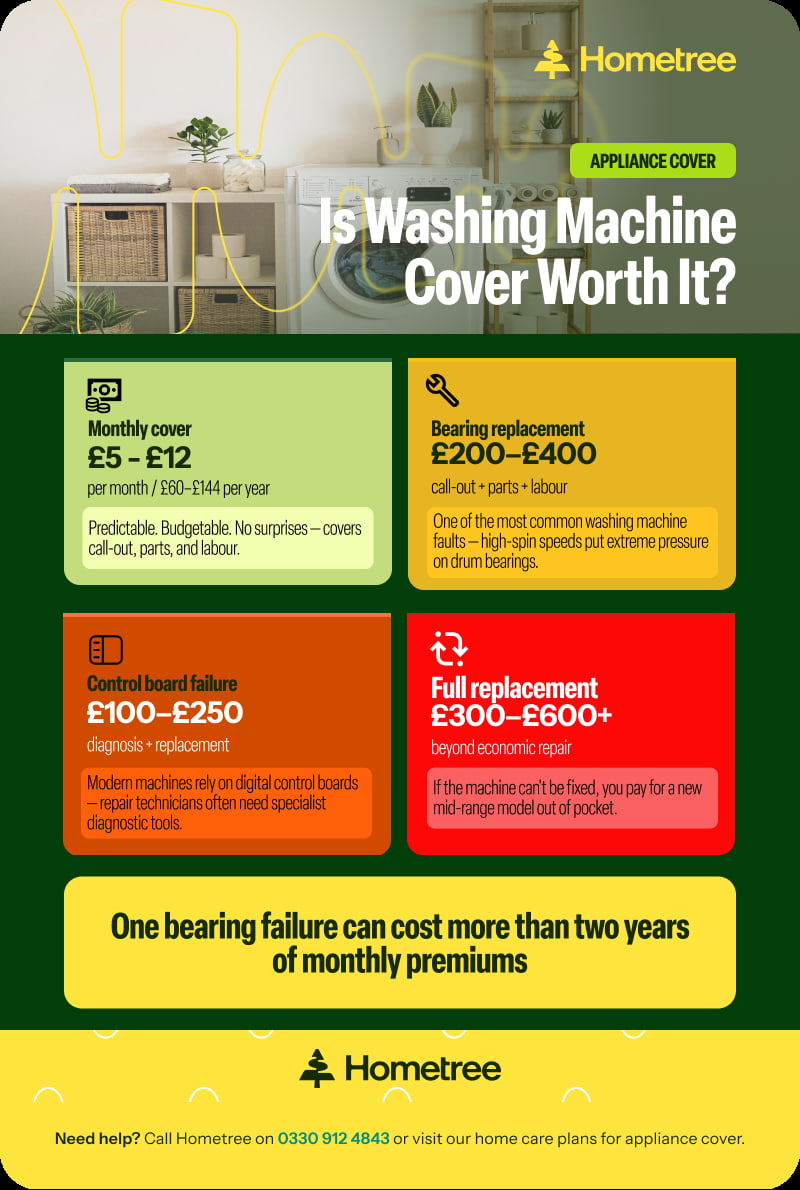
Washing machine insurance typically costs between £5 and £12 per month (£60 to £144 per year) for a single appliance.
Without cover, a single repair visit tells a different story:
- Call-out fee: £50–£100 just to get an engineer through the door
- Drum bearing replacement: £150–£300 including parts and labour
- Control board failure: £100–£250 for diagnosis and replacement
- Beyond economic repair: A new mid-range machine costs £300–£600+
One bearing failure can cost more than two years of monthly premiums.
Situations when washing machine cover is (and isn’t) worthwhile
Cover tends to be worth it if your washing machine is out of warranty but under eight to ten years old.
It’s also worth it if you have no savings for unexpected repair bills or you’re a landlord where a breakdown can cause a tenant dispute.
It’s less necessary if your machine is still within its manufacturer’s warranty or it’s very old.
Some insurers won’t cover machines past a certain age, and parts become difficult to source.
It’s also not often necessary if your savings enable you to comfortably absorb an occasional repair bill.
So, in short: for most households with an out-of-warranty machine and no dedicated repair fund, the monthly premium is affordable and – importantly – predictable.
And the alternative (a sudden £250 repair or a £400 replacement) is neither.
Landlord responsibilities and rental realities
Landlords are legally responsible for ensuring that all supplied appliances are safe and in working order. When a washing machine breaks in a rental property, it causes major issues:
- Tenant disruption: Laundry tasks stop, which can trigger tenancy disputes.
- Property damage: A leaking pipe can damage floorboards and cause mould.
- Unexpected costs: Emergency call-out fees drain your rental yields.
It’s also worth noting that tenants are unlikely to clean the washing machine (and other appliances) as much as homeowners, as it’s not their property.
A landlord appliance policy acts as a commercial shield. It provides a direct route to get a qualified engineer to the property quickly. And it protects your cash flow while keeping tenants satisfied.
Washing machine protection myth-busting
Let’s deconstruct four common misconceptions about washing machine care:
Myth 1: “Low-temperature washes are always best.”
Cold washes protect delicate colours. But running exclusively cold cycles allows detergent grease, lint, and bacteria to build up. You must run regular hot cycles to clean the internal piping.
Myth 2: “All repair plans offer the same consumer protections.”
There is a major legal difference. Insured repair plans are underwritten by an insurer and regulated by the Financial Conduct Authority (FCA). Non-insured maintenance plans are service agreements without these legal safeguards.
Myth 3: “I can easily dump my old machine at the local tip.”
This is partly true. Under the Waste Electrical and Electronic Equipment (WEEE) regulations, anything with a plug, battery, or cable must be recycled rather than put in general waste.
Myth 4: “My home care plan covers my washing machine.”
Most home emergency plans only cover boilers or plumbing. A specialist policy ensures you get engineers with specific appliance credentials and direct access to brand-approved parts.
Get your home appliances covered with Hometree
Our home appliance cover includes unlimited repairs, an annual boiler service, zero parts & labour charges, and 24/7 claims support to keep your home warm. Subject to exclusions and T&Cs apply.
With no hidden fees and coverage across England, Scotland, and Wales, we’ve got you covered.
You can get covered today or contact us for a free quote.


Get a free appliance cover quote

We Beat or Match Any Quote
Phone us to beat or match British Gas or Homeserve quotes, Terms apply.

Serious About Service
24/7 claims support & rated Excellent on Trustpilot

Cover Match Guarantee
£50 gift card if we don’t cover something British Gas or Homeserve do, terms apply

All Gas Boilers Covered
All makes and models, regardless of age