Home Appliance Insurance: What It Covers, Costs & Whether It’s Worth It

Much of our day-to-day lives depend on our home appliances running smoothly.
Sudden breakdowns cause stress and financial strain.
As with many of life’s issues, understanding this often comes too late! So, in this article we’ll look at:
- The realities of appliance lifespans
- The hidden vulnerabilities of modern technology
- Why household goods are getting more expensive
- The protective limits of insurance.
And more!
Appliance cover: A definition
Home appliance cover is a monthly or annual policy that pays for the potential cost of repairing or replacing your household appliances when they break down.
It’s a kind of insurance for ‘white goods’ (see below) that often includes:
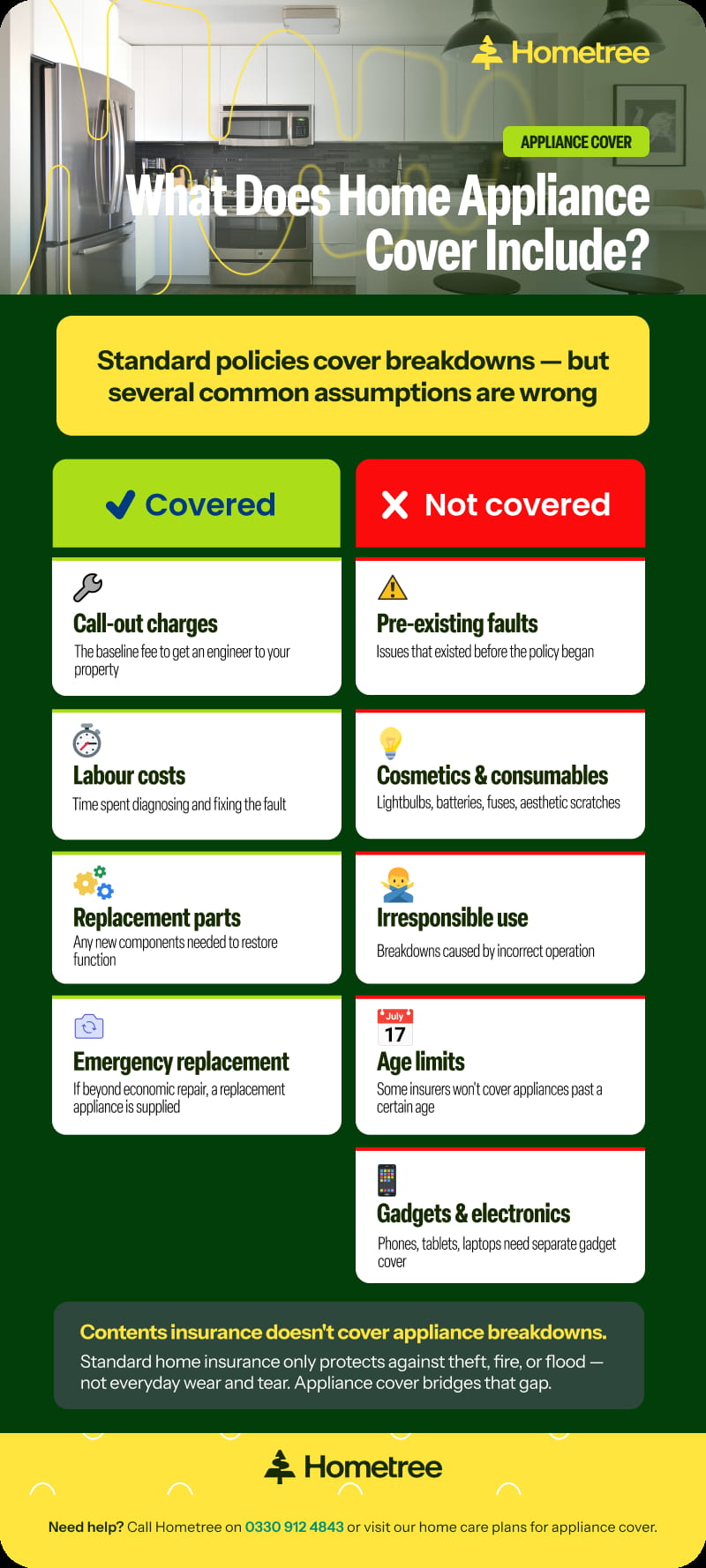
- Call-out charges: The baseline fee to get an engineer to your property.
- Labour costs: The technical time spent diagnosing and fixing the fault.
- Appliance parts: The cost of any new components needed to restore function.
- Emergency replacements: If an expert technician determines an appliance is beyond economic repair, a quality provider will supply a replacement within a realistic timeframe.
Appliance cover costs
Home appliance insurance typically costs between £5 and £15 per month for a single appliance.
It rises to £20–£40 per month for a multi-appliance package covering your whole kitchen.
The exact premium depends in part on the age and type of appliance. And in part on the provider’s response time guarantee, and whether the policy carries an excess (which is usually £50–£100 per claim).
To put this in context:
- A washing machine repair (call-out, parts, and labour) typically costs £150–£300
- A fridge-freezer can cost £400–£800 to replace.
So, a multi-appliance policy at £30 per month can pay for itself in comparison to a single significant breakdown in the year.
Redefining white goods: Design, complexity & choice
Historically, the term white goods referred to large electrical kitchen appliances that were coated in white enamel, such as:
- Refrigerators
- Washing machines (Note: Standalone washing machine cover does exist, too)
- Cookers
- Tumble dryers
- Dishwashers
- Microwaves.
Manufacturers eventually came up with solutions to provide a wide range of colours. (But the term is still used, especially in the context of cover/insurance.)
They also came up with a range of sizes, models, and features, for each category.
This gives consumers much more choice. But perhaps in some cases it’s too much choice! Everyone must navigate what upfront costs and potential repair bills are worth paying extra for.
Manufacturing complexity and consumer repairs
In The Origins of Efficiency (2026), Brian Potter points out that manufacturing runs best (and cheapest) when processes are standardised. In markets with many customised designs, that easy, low-cost coordination breaks down.
In the appliance world, this means those unique features and models can turn repairs into an expensive puzzle rather than a cheap fix.
Of course, new smart features often improve appliances. However, sometimes they create problems, such as:
- Electronic vulnerability: A malfunctioning digital control panel on an oven, for example, is not just a minor electronic glitch. It creates a safety concern
- Mechanical strain: Complex water delivery systems in high-end dishwashers are prone to mechanical failures
- The lifespan reality: Some argue that the lifespan of modern appliances has become highly unpredictable or even shorter.
So, given the relative fragility of modern appliances, a robust safety net has become a critical necessity rather than an optional luxury.
Does contents insurance cover kitchen appliances?
No, standard contents insurance does not cover kitchen appliance breakdowns. Policies protect against events like theft, fire, or flood, but explicitly exclude failures from everyday wear and tear.
Many homeowners mistakenly assume that their home insurance or initial warranties provide protection for appliance breakdowns.
In reality, home appliance insurance (or domestic appliance insurance) is designed to bridge the gap between manufacturer’s warranties and standard contents insurance.
To understand why this matters, consider the following:
- Contents insurance often protects your home against catastrophic events. It excludes breakdowns caused by everyday wear and tear.
- Manufacturer warranties typically last one to two years on products that often last much longer.
Common policy exclusions
Not every policy is the same, and you must review your terms for key exclusions. Most standard policies will not cover:
- Pre-existing faults that occurred before the policy began
- Cosmetics and consumables such as lightbulbs, batteries, fuses, or aesthetic scratches
- Irresponsible use or breakdowns caused by failing to operate the appliance correctly
- Age limits enforced by some insurers who refuse to cover appliances past a certain age
- Gadgets and electronics (e.g., phones, tablets, laptops), which are strictly excluded and require separate gadget cover.
Rental properties’ appliance issues
Safe, functioning appliances are an essential part of a landlord’s maintenance responsibilities.
Common appliance issues are common in rental properties. High tenant turnover can accelerate wear and tear. And when a cooker or washing machine breaks down, the expenses can affect rental yields.
Bespoke landlord appliance insurance can improve a landlord’s operations, especially when there are multiple properties being covered. It can ensure quick repairs, minimal cash flow problems and happier tenants.
Strategic care: Preventing a trip to the dump
Appliance cover is a great backstop, but it should work alongside proactive maintenance. Proper care of your household equipment helps you avoid a trip to the dump.
For example, in heating systems, skipping a proactive boiler service often leads to more boiler breakdowns and emergency repair bills (call-outs, parts, and labour), often £500 – £800+.
By contrast, a regular safety check can catch developing faults before they become costly failures. Applying this same proactive logic to your kitchen white goods will extend their lifespan and increase their efficiency.
You’ll prevent minor issues with filters, door seals, etc., from deteriorating into serious problems.
Appliance protection myth-busting
Myth 1: “My new appliances are immune to breakdowns.”
Modern appliances are incredibly complex. They are not immune from a range of issues (poor installation, faulty components, manufacturing defects, etc.) that can trigger sudden failures even in brand-new and premium models.
Myth 2: “All appliance repair plans are regulated.”
There is a crucial regulatory difference. Insured plans are underwritten by an insurer and strictly regulated by the Financial Conduct Authority (FCA). Non-insured maintenance plans are service agreements that don’t carry these regulatory backstops.
Myth 3: “Every engineer is qualified to repair any appliance.”
Just because an engineer can fix a washing machine doesn’t mean they can legally touch your gas cooker. In the UK, qualifications are highly specific.
For example, working on gas appliances legally requires up-to-date credentials on the Gas Safe Register.
Myth 4: “I can easily organise my own repairs if needed.”
Organising individual call-outs involves:
- Vetting technicians
- Navigating unpredictable fees
- Potentially waiting days for an appointment.
A dedicated policy should guarantee a fast response time (typically an engineer on your property within 24 to 48 hours).
Is home appliance insurance worth it?
Appliance cover’s value depends on your circumstances. It tends to be worth it if you have:
- Multiple appliances past their warranty period
- No or low savings
- Rental properties
For most households with several white goods past the two-year mark and no dedicated repair fund, the maths typically favour cover.
And the monthly premium is predictable, whereas the alternative – a sudden £600 fridge-freezer replacement, for example – is not.
Get your home appliances covered with Hometree
Our home appliance cover includes unlimited repairs, an annual boiler service, zero parts & labour charges, and 24/7 claims support to keep your home warm. Subject to exclusions and T&Cs apply.
With no hidden fees and coverage across England, Scotland, and Wales, we’ve got you covered.
You can get covered today or contact us for a free quote.


Get a free appliance cover quote

We Beat or Match Any Quote
Phone us to beat or match British Gas or Homeserve quotes, Terms apply.

Serious About Service
24/7 claims support & rated Excellent on Trustpilot

Cover Match Guarantee
£50 gift card if we don’t cover something British Gas or Homeserve do, terms apply

All Gas Boilers Covered
All makes and models, regardless of age