Fuse Box Keeps Tripping? 7 Causes Explained

Today, most homes have modern consumer units that use trip switches.
(These are different from traditional fuse boxes, which have carriers containing fuse wire. Repairing blown fuses is a different process.)
If they trip, it’s often a case of flicking a switch back up, rather than replacing a fuse wire.
Follow these simple steps to fix yours.
Important safety note: Please be aware that faulty electrics are very dangerous. If you are not confident in your ability to carry out electrical tasks, seek help from a qualified electrician.
Step 1: Turn off light switches and unplug devices
Turn off light switches and unplug the devices in the areas of your home that are now without power.
You may be overloading your circuits or have a faulty device here. You don’t want them causing the exact same issue once you have turned the power back on.
Step 2: Locate your consumer unit
This might be in one of several rooms.
Each property is different. However, try the following:
- Garages
- Utility rooms
- Hallways
- Cupboards under stairs.
Step 3: Check the switches
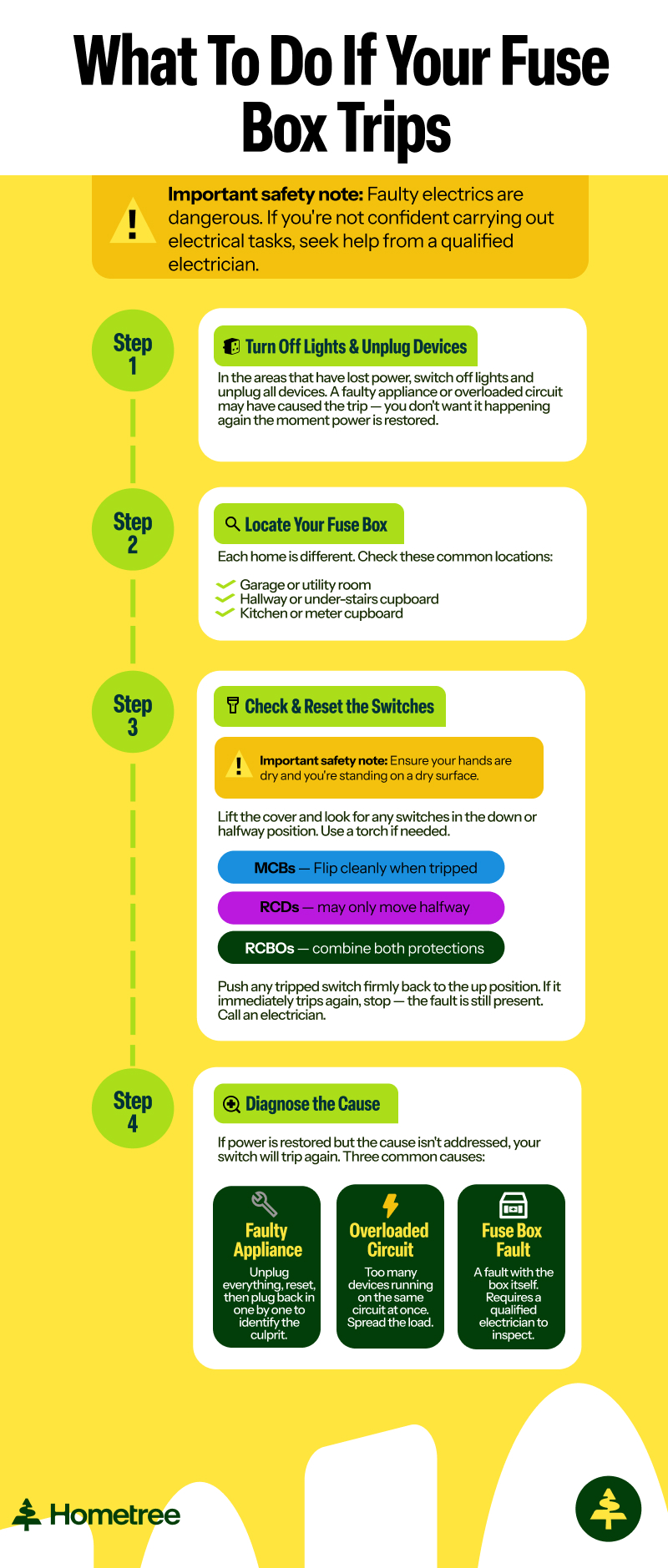
Important safety note: Make sure you have dry hands and are standing on a dry surface.
Lift the cover and check the position of your fuse switches.
There are often several different switches, depending on your consumer unit model. Common ones include:
- The main switch. It turns off the electricity supply to your home. Useful in an emergency.
- MCBs (or circuit breakers). These trip to protect appliances in your home if there’s a fault in the circuit. They provide more accurate protection than traditional wire fuses.
- RCDs (Residual Current Devices). Switches that will trip and turn off the electricity when they detect imbalances between live and neutral current (i.e., earth leakage). They are designed to prevent electrocution and electrical fires caused by earth faults.
- RCBOs (Residual Current Breaker with Overcurrent protection). These combine RCD (earth fault/electrocution risk), MCB overcurrent protection (overloads/short circuits) in a single unit.
If any are pointing down, then they have tripped and need flicking back to the up position.
Look carefully, with a torch if needed. Switches have often obviously moved position, but sometimes the change is more subtle.
Not sure whether ‘on’ means consumer unit switches up or down?
See if the majority are up or down and you’ll have your answer. It’s most likely to be the up position for ‘on’ and the down position if they’ve tripped.
Check both your:
- MCBs (the smaller toggle switches): These typically flip clearly to the down position when tripped.
- RCDs (the wider switches, usually with a test button): These might be trickier to spot — they sometimes only move to a halfway position rather than fully down.
If multiple circuits have lost power at once, an RCD is the more likely cause, as each one covers several circuits.
To reset, push any tripped switch back into the ‘up’ position.
If it immediately trips again, the underlying fault is still present. Do not keep resetting it. At that point, you should speak to a qualified electrician.
Step 4: Try to diagnose the problem
Your switch is likely to trip again if the cause of your cut isn’t addressed.
If you’re lucky, your consumer unit will have labels under switches listing the circuit they manage, e.g. lights, shower, sockets.
A faulty appliance
If your box isn’t labelled or you can’t narrow down the problem, you can:
- Unplug every device in your home
- Reset the switch
- Plug them back in one at a time.
It’s time-consuming but should find the root of your problem.
Perhaps you have too many devices plugged in in a single room. Or maybe one appliance is tripping the switch.
The last appliance or light fixture you used might be the cause.
(In this case, then you’ll need to unplug it, reset your switch and get the appliance looked at by a qualified electrician.)
You don’t necessarily need to throw the appliance away. The issue could be an easy fix for a professional.
Important safety note: Don’t try to use an appliance you suspect is tripping your fuse switch – it could be a potential hazard.
Overloaded circuits
If all of your appliances are in good working order, they’re unlikely to affect your switches.
Instead, it could be down to you overloading your circuits, i.e., using too many electrical appliances at one time.
You could be running several tasks on the same circuit simultaneously, for example:
- A kettle
- A toaster
- A dishwasher
- A washing machine.
Your consumer unit will treat this as potentially dangerous and respond by tripping.
Note: If there is a wider power cut in your area, no switches will turn off.
Consumer unit issues
Alternatively, there may be a fault with the consumer unit itself.
This will need to be examined and repaired by an electrician. In some cases, you may need to speak to them about consumer unit replacement cost and installation.
Rather leave it to the experts?
Would you rather a professional handle your consumer unit’s issues?
Our comprehensive home cover and plumbing, drains & electrics cover can give you peace of mind about the causes (and costs) involved.
Hometree offers home care plans you can trust, with quick and convenient call-outs and a 24/7 UK helpline.
What’s more, we don’t put caps on claims!


Cover Electrics From £1.50 A Month

We Beat or Match Any Quote
Phone us to beat or match British Gas or Homeserve quotes, Terms apply.

Serious About Service
24/7 claims support & rated Excellent on Trustpilot

Cover Match Guarantee
£50 gift card if we don’t cover something British Gas or Homeserve do, terms apply

All Gas Boilers Covered
All makes and models, regardless of age