Gas Safety Check: What It Involves, Cost & How Long It Takes

Gas is a crucial component of running most homes.
However, it comes with several potential dangers, including gas explosions and carbon monoxide poisoning.
Fortunately, incidents involving these are getting rarer. This is due to strict regulation, and diligent work by heat engineers.
Read on to learn about the role gas safety checks play in keeping the UK’s buildings safe.
Annual gas safety checks
An annual gas safety check is an inspection of all gas appliances in a home.
It involves an inspection by a Gas Safe registered engineer of all gas-powered systems or appliances in your home or business. This generally includes everything related to heating, hot water, cooking, and more.
After the check, you’ll receive a Gas Safe certificate valid for 12 months.
How long does a gas safety check take?
A gas safety check typically takes between 30 minutes and one hour.
The exact time depends on how many gas appliances the engineer needs to inspect and how accessible they are.
To keep things running smoothly on the day:
- Clear clutter around the boiler and any airing cupboards before the engineer arrives.
- Make sure all appliances are switched on and accessible.
What gas safety checks involve
A gas safety check covers every gas appliance in a home, including:
Under Regulation 26(9) of the Gas Safety (Installation and Use) Regulations 1998, a compliant check is more than a visual inspection. Your Gas Safe engineer must confirm:
- Operating pressure: The appliance is burning gas at the correct pressure
- Combustion: Gas is burning cleanly, with no signs of incomplete combustion
- Ventilation: Air supply is adequate and vents are clear
- Flue and chimney flow: Waste gases and fumes can safely discharge outside
- Safety devices: Flame supervision devices and other controls are working correctly
- Installation: Appliances are safely installed and appropriate for their location.
Gas safety check costs
Gas safety check prices aren’t regulated. So, it’s worth getting a few quotes before you commit, which can range from £30 to £150, depending on your location and provider.
(However, don’t assume the cheapest price is the best service. Do other research, too.)
Typically, expect to pay between £60 and £100 for a standard check covering a boiler and one or two additional appliances.
Some engineers charge a set rate for the boiler and a small additional fee per extra appliance.
Tip: book in summer
Engineers are busiest from autumn through winter, when boiler breakdowns are more likely to happen.
Booking your check during the warmer months often means:
- Better availability
- Shorter wait times
- More competitive pricing.
Free gas safety checks
Some energy suppliers offer free checks, particularly for customers on vulnerable tariffs. It’s worth checking with your supplier to see if you qualify.
If you have boiler cover
Your annual gas safety check may be included as standard for your boiler cover (or landlord boiler cover). You won’t need to organise or pay for it separately.
Do I need a gas safety check?
Homeowners
A gas safety check is not a legal requirement for homeowners but it’s strongly recommended.
All gas appliances carry the risk of producing carbon monoxide leaks. It’s a colourless, odourless gas that can be fatal in enclosed spaces. Regular checks by qualified engineers significantly reduce that risk.
Tenants
Tenants don’t need to arrange gas safety checks – it’s the landlord’s responsibility.
However, they should ask their landlord for a copy of the Gas Safe certificate to confirm the property has been properly inspected.
Landlords
If you own a rental property with gas appliances, you are legally required to organise an annual gas safety check under the Gas Safety (Installation and Use) Regulations 1998.
Afterwards, you’ll receive a Landlord Gas Safety Record (LGSR) (also known as a CP12). You must give a copy of this to your tenants and save one yourself on file. Failure to comply is a criminal offence.
If a local authority discovers that your property doesn’t have the correct selective licence, they will demand to inspect whether everything else is up to code (specifically your EPC and your Landlord Gas Safety Record.)
This simple licensing oversight can trigger a full gas safety inspection and expose you to prosecution if your certificates are out of date.
If you use a letting agency, keep in mind that you both share this legal risk. Keeping your Gas Safe inspections up to date isn’t just your legal duty—it’s a mutual priority that keeps both you and your agent protected from serious fines.
Gas safety check vs boiler service

These are two separate services that are often confused. Which can be an expensive mistake.
Gas safety checks confirm that your appliances are operating safely and not producing dangerous levels of carbon monoxide.
Boiler services are preventative maintenance. An engineer inspects and cleans, adjusts and/or fixes the boiler.
A boiler service isn’t a legal requirement on top of the gas safety check. However, a well-maintained boiler is far less likely to fail.
So you could potentially save yourself emergency call-out charges (sometimes £300+), or even a full boiler replacement (between £1,500 and £3,000).
Who can carry out a gas safety check
Only engineers registered with the official Gas Safe Register can legally perform gas safety checks. You can search for a registered engineer at gassaferegister.co.uk.
Before you let anyone in, check their ID card. A genuine Gas Safe engineer’s card should show:
- Photo and employment details
- A valid licence number and security hologram
- Qualifications, along with their issue and expiry dates. Note: Gas qualifications must be renewed every five years, and engineers need separate qualifications for each appliance type they inspect
If an engineer’s card doesn’t cover a particular appliance in your home, they cannot legally complete the check for it.
A registered engineer can also offer practical safety advice about carbon monoxide risks and the best way to maintain your appliances between checks.
When checks reveal a problem
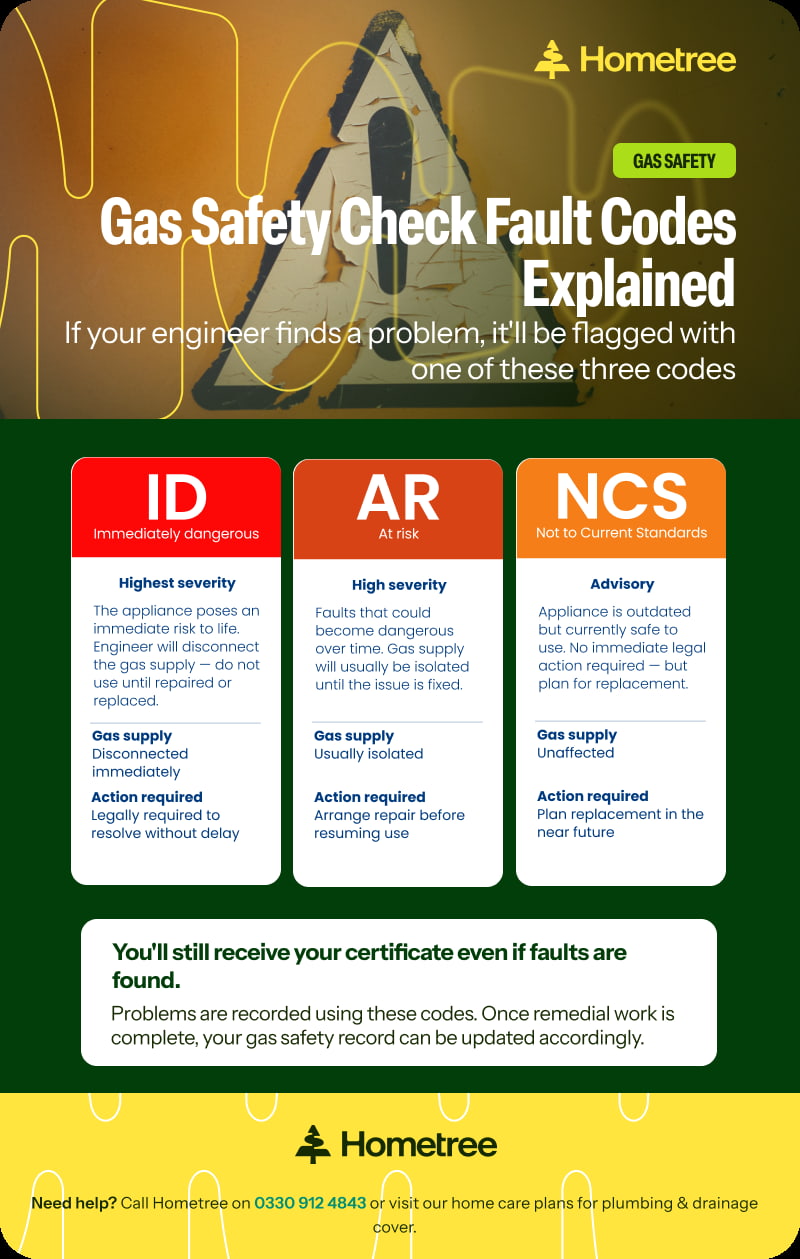
You’ll receive your gas safety certificate at the end of the visit even if the engineer identifies issues. Problems are recorded using standard industry codes:
Immediately Dangerous (ID)
The appliance poses an immediate risk to life. The engineer will disconnect the gas supply and no one should use it until it has been repaired or replaced. You are legally required to resolve the issue without delay.
At Risk (AR)
The appliance has faults that could become dangerous over time. Gas supply will usually be isolated until it is fixed.
Not to Current Standards (NCS)
The appliance is outdated but currently safe to use. You should consider replacing it in the near future to avoid future safety concerns.
Councils can issue civil penalties of up to £30,000 per offence if your property fails to meet local licensing requirements. You could also face a Rent Repayment Order (RRO), which legally forces you to pay up to 12 months of rent back to your tenants or directly to the council.
You are legally required to act on any safety concerns raised by a Gas Safe engineer. Once remedial work is complete, your gas safety record can be updated accordingly.
Overview: Gas usage in Britain
Gas was first used to light a home in Britain in 1792 when William Murdoch began experimenting with coal gas at his cottage in Redruth, Cornwall.
His employer, the firm Boulton & Watt, later used gas to illuminate their Birmingham factory in 1802. This was one of the earliest large-scale demonstrations of gas lighting.
By the 19th century, gas was common across British towns and cities. It was first used for street lighting, then came domestic use. Cooking by gas followed, with room heating and eventually central heating arriving later.
However, the gas used at this point was produced by burning coal (known as ‘town gas’). Natural gas became the dominant form from the mid-1960s onwards, when large deposits were discovered beneath the North Sea.
Between 1966 and 1977, Britain completed a nationwide programme to convert every gas appliance in the country. At the time, this was one of the largest logistical operations in peacetime history to-date.
There were several major gas explosions during this era. One at Ronan Point, London in 1968 led to British Gas setting up the Council for Registered Gas Installers (CORGI) in 1970.
Between 1991 and 2009, CORGI registration was a legal requirement for all engineers carrying out gas installation, maintenance, and repair work in Great Britain. Gas Safe Register replaced CORGI as the official registration body in April 2009.
Gas safety today
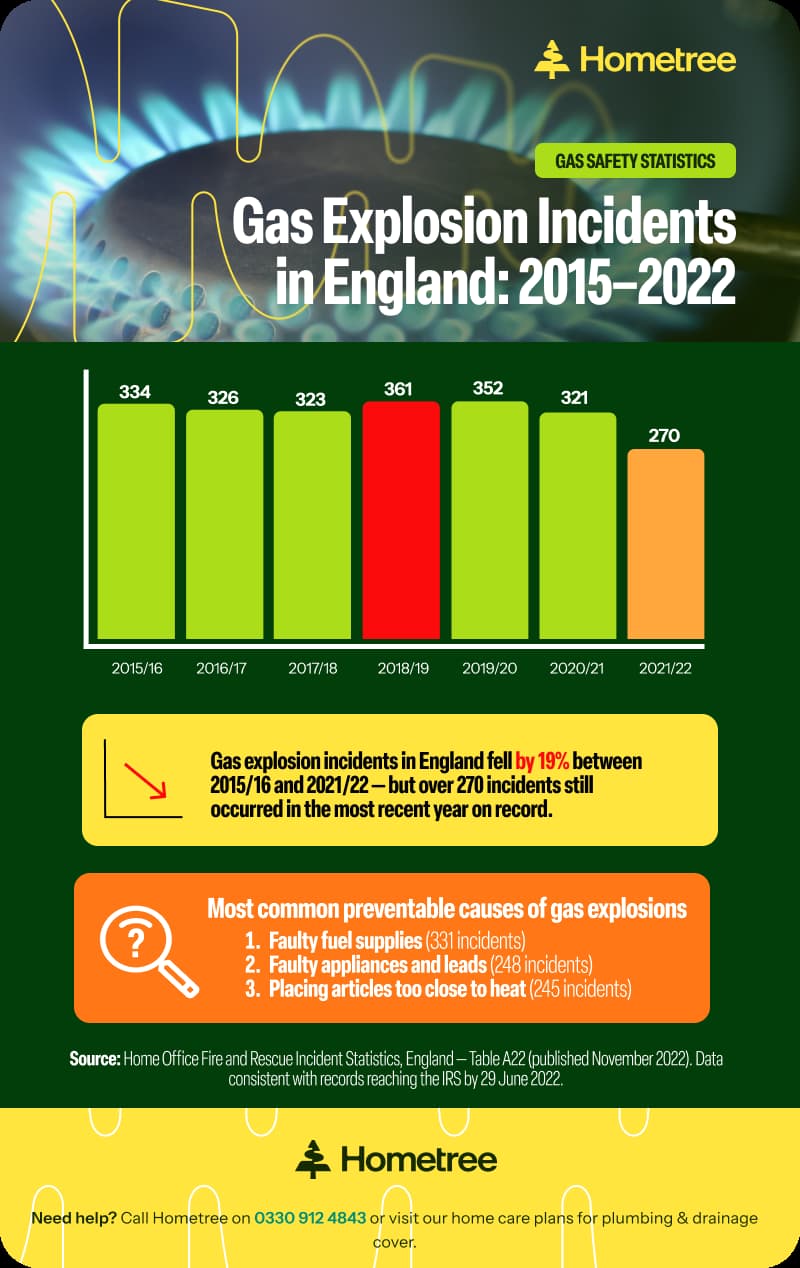
Gas explosions are relatively rare today in the UK. In 2021/22, there were 270 fires involving gas and explosions, 100 casualties, and 4 fatalities.
Carbon monoxide (CO) poisoning caused by gas leaks and faults is more common but less often fatal. Fire and rescue services attended 1,623 CO-related incidents in 2019 (calendar year), resulting in 212 casualties and 17 fatalities.
Underlying much of this is defective gas work. In 2020-21, Gas Safe Register found 3,168 gas fittings classed as “At Risk” or “Immediately Dangerous” during inspections and investigations.
A reminder that regular servicing by a registered engineer remains the front line of prevention.
Get your home appliances covered with Hometree
Our home appliance cover includes unlimited repairs, an annual boiler service, zero parts & labour charges, and 24/7 claims support to keep your home warm. Subject to exclusions and T&Cs apply.
With no hidden fees and coverage across England, Scotland, and Wales, we’ve got you covered.
You can get covered today or contact us for a free quote.


Get a free home cover quote

We Beat or Match Any Quote
Phone us to beat or match British Gas or Homeserve quotes, Terms apply.

Serious About Service
24/7 claims support & rated Excellent on Trustpilot

Cover Match Guarantee
£50 gift card if we don’t cover something British Gas or Homeserve do, terms apply

All Gas Boilers Covered
All makes and models, regardless of age