How Efficient Is Your Boiler?

Heating accounts for roughly 53% of the average UK household energy bill.
And at the core of most homes here, lies the boiler.
Read on to learn how efficient your boiler is, what this means for your bills, and how you can improve it.
How efficient are modern boilers?
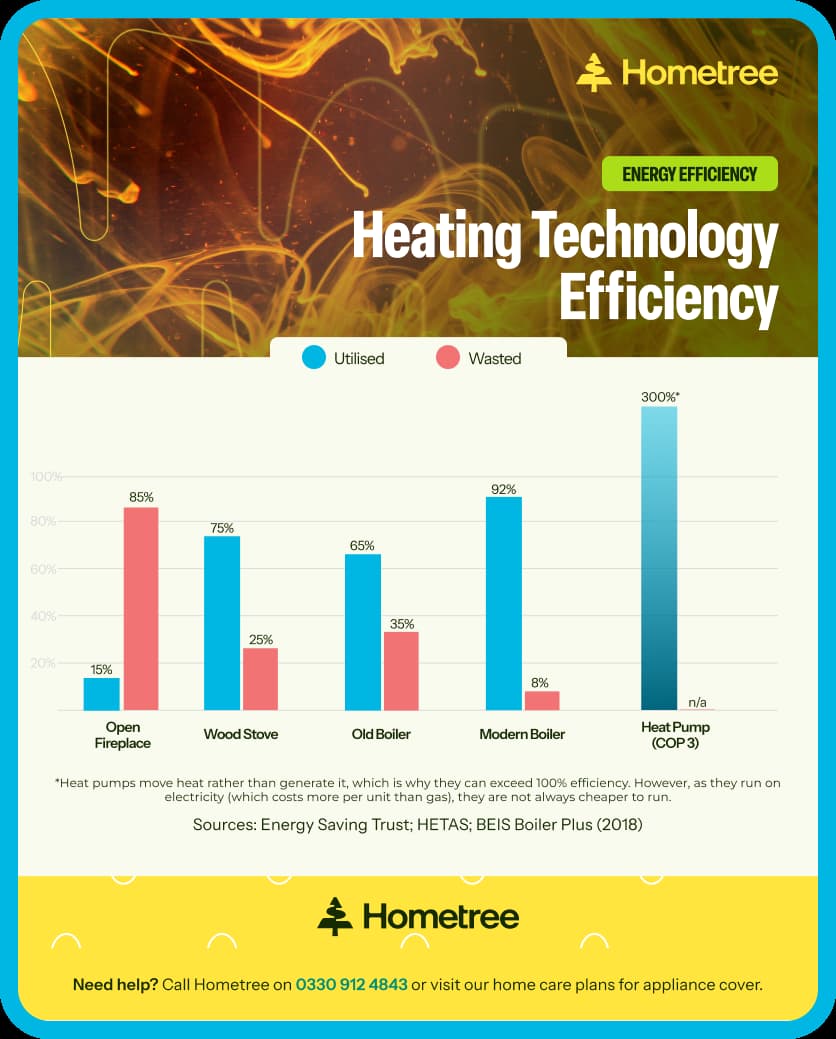
Modern boilers really are around 90%+ efficient. This means that for every unit of energy contained in the gas the boiler burns:
- At least 90% gets used. It’s converted into usable heat for your radiators and hot water.
- 10% or less is lost. It escapes mainly as heat up the flue in exhaust gases.
Since the 2018 Boiler Plus legislation, new boilers must be at least 92% efficient.
Boilers more than 20 years old can be as low as 60%. However, this is still more efficient than open fires (around 10–20% efficient or lower).
But it’s not as efficient as modern heat pumps, which can technically exceed 100% efficiency.
(However, it’s not an entirely accurate comparison because heat pumps use electricity to move heat rather than directly using fuel to create it.)
How to check your boiler’s efficiency rating
There are three straightforward methods to find the efficiency rating of your boiler:
- Check the boiler’s data plate: Look on the front casing or underneath the plastic cover of your appliance for a small metal data plate. This plate lists your boiler’s model details and will display either its ErP letter rating or a SEDBUK percentage score.
- Search the PCDB database (PCDB): This can be found on a searchable directory of domestic systems at boilers.org.uk. You can enter your boiler’s brand and model name to instantly find its official seasonal efficiency rating.
- Check your Energy Performance Certificate (EPC): Your home’s EPC includes an evaluation of the efficiency of your heating systems. You can view your property’s EPC online for free using the government register.
Understanding boiler efficiency ratings
Boiler efficiency in the UK is measured using two key rating scales.
Seasonal Efficiency of a Domestic Boiler in the UK (SEDBUK) ratings
These ratings express efficiency as a percentage:
- A: 90%+
- B: 86–90%
- C: 82–86%
- D: 78–82%
- E: 74–78%
- F: 70–74%
- G: below 70%
Energy-related Product (ErP) ratings
This EU system utilises a letter-based scale from A+++ down to G. Most modern gas boilers sold today are A-rated under this European standard.
Boiler efficiency comparison by type
Combi, system, and conventional boilers
The three main domestic boiler types each handle hot water differently, which affects their efficiency.
Combi boilers (the most popular kind in the UK) heat water on demand with no storage cylinder. This removes standby heat loss, making them the most energy-efficient option for smaller homes.
System boilers heat water stored in a cylinder. A well-insulated modern cylinder loses very little heat in standby (only about around 1–2% to running costs compared to a combi).
Conventional (regular) boilers require both a hot water cylinder and a cold-water header tank in the loft.
The additional pipework marginally for this increases heat loss, making them the least efficient of the three. However, the difference is small.
In fact, boiler type has far less impact on efficiency than whether the appliance is condensing, how old it is, and how low you set the flow temperature.
Condensing boilers
Whether you choose a combi or system model, modern gas condensing appliances are the gold standard, typically operating at 89% to 95% efficiency.
Condensing boilers have a secondary heat exchanger. This captures the latent heat from the escaping water vapour and recycles it back into the heating system.
Old boilers
Systems installed before 1994 are typically non-condensing. These older units operate at a 55% to 75% efficiency.
Electric boilers
Electric boilers are incredibly efficient on paper, converting 99% to 100% of electricity into heat. However, electricity costs roughly three to four times more per unit than gas in the UK.
This means that while an electric boiler is technically highly efficient, its actual running costs are significantly higher than gas systems.
How old is too old for a boiler?
Domestic boilers are built to last, but they do have limited lifespans. If your boiler is over 15 years old, it is likely operating below its original efficiency.
A rule of thumb is that if your appliance has a G-rating or operates below 80% efficiency, it is time to consider a replacement.
Upgrading to a modern condensing boiler can be a significant upfront cost. But the investment typically pays for itself within 5 – 10 years through your lowered monthly heating bills (i.e., lower than they’d otherwise be).
How to improve your boiler’s efficiency
Lower your boiler’s flow temperature
This is the most impactful improvement most homeowners can make, yet very few actually do. Most combi boilers are set to a default flow temperature of 80°C.
However, condensing boilers only achieve their high efficiency when the return water temperature is below 55°C.
Reducing your boiler’s flow temperature to 60°C or lower keeps the system in condensing mode more often. This saves you gas without making your home feel cold.
Book an annual boiler service
Over time, debris can build up on the heat exchanger, acting as an insulating layer that blocks heat transfer.
A dirty heat exchanger loses efficiency rapidly. Booking an annual service ensures a qualified Gas Safe engineer can clean and tune the system to optimise its peak rating and reduce the chances of boiler breakdowns later on.
Install a smart thermostat
Modern controls give you more power over your heating. Since 2018, all new gas boiler installations in the UK must include advanced time and temperature controls.
A smart thermostat prevents your system from running when it is not needed.
Fit thermostatic radiator valves (TRVs)
These smart valves don’t just turn boilers on and off. They also regulate the flow of water through individual radiators based on room temperature.
This prevents empty guest rooms from overheating and ensures you only burn fuel where it is actually needed.
Bleed your radiators regularly
When air is stuck inside your radiators, it creates cold spots and reduces the total heat output.
So, your boiler has to run for longer and work harder. Bleeding your radiators once a year releases this air.
Insulate exposed pipework
Hot water can lose a significant amount of heat as it travels from your boiler to your radiators.
Lagging exposed pipes in unheated areas with foam insulation sleeves reduces this heat loss.
Piping is often exposed in places such as your loft, basement, or garage.
Get your boiler covered with Hometree
Our boiler cover includes unlimited repairs, an annual boiler service, zero parts & labour charges, and 24/7 claims support to keep your home warm. Subject to exclusions and T&Cs apply.
With no hidden fees and coverage across England, Scotland, and Wales, we’ve got you covered.
You can get covered today or contact us for a free quote.


We Beat or Match Any Quote
Phone us to beat or match British Gas or Homeserve quotes, Terms apply.

Serious About Service
24/7 claims support & rated Excellent on Trustpilot

Cover Match Guarantee
£50 gift card if we don’t cover something British Gas or Homeserve do, terms apply

All Gas Boilers Covered
All makes and models, regardless of age